
There’s no denying that Apple revolutionized the XR industry when it introduced its spatial computing headset, the Apple Vision Pro. Unfortunately, the price of the headset is a major sticking point for a lot of consumers. Enter the Immersed Visor.
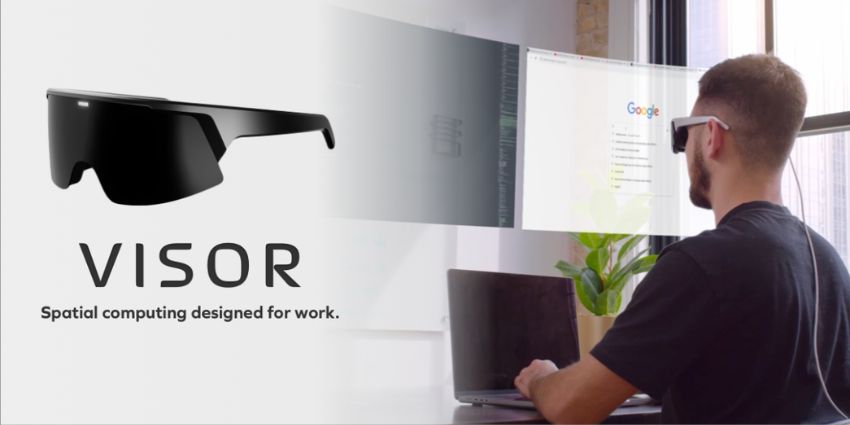
Introduced at the Immerse Global Summit in 2023, the Immersed Visor promises users a spatial computing experience similar to that offered by the Apple Vision Pro for a fraction of the price. According to Immersed, it’s the world’s smallest “4K headset”, closer in style to a pair of powerful smart glasses than a full mixed reality headset.
On paper, the Visor almost seems too good to be true. It promises 4K resolution per eye, excellent ergonomics, and support for all your favorite apps, including Microsoft Teams.
So, will the Immersed Visor steal customers from Apple when it’s released? Here’s everything we know so far.
What is the Immersed Visor?
The Immersed Visor is an ultra-compact spatial computing device that combines micro-OLED displays with HD color passthrough, eye tracking, and inside-out tracking. It was designed by Immersed, the company best known for its remote VR desktop app.
Like many headset and smart glasses vendors making waves in the XR space today, Immersed isn’t focusing exclusively on consumers with its new wearable.
The company’s official website for the Visor highlights the system’s wide range of uses for professionals. The system allows users to create up to five ultra-high-resolution 4K virtual screens and interact with apps like Slack, PowerPoint, Google Docs, Excel, and more.
Though the Immersed Visor has yet to be officially released, we already have specs for two headset versions. The standard “Visor 4K” features:
- 4K micro OLED screens per eye
- Online and offline mode
- 5 customizable screens
- 100-degree field of view
- 6 Degrees of freedom
- Custom IPD, nose insert, and light blocker
- HD color passthrough
- A 3-hour extended battery pack
- Hand and eye tracking
The Founder Edition includes all of those features, as well as a limited edition design, lifetime subscription to “Immersed Pro”, and a signature colored front plate.
Pricing and Availability: How Much Does it Cost?
Part of what makes the Immersed Visor such an exciting addition to the XR market is its pricing. While spatial computing devices like the Apple Vision Pro will set you back a hefty $3,500, the Immersed Visor is available for as little as $400 with some caveats.
The standard 4K headset costs $399.99, but you must pay for a subscription to the Immersed software bundle, “Visor Plus”. You can purchase a subscription alongside the headset, or you can get a pre-paid lifetime subscription with the headset for $1,049.98.
If you want one of the limited “Founder’s Edition” headsets, that will cost $699.99 for the headset, or $1,349.98 with the included software subscription. Obviously, the subscription ramps the pricing up a little, but the headset will still be a lot less expensive than the Apple Vision Pro.
The Immersed Visor: Functionality and Features
So, what can the Immersed Visor actually do? At this point, we’re still waiting for access to the headset, so it’s difficult to give a comprehensive review. However, we do know that the Visor is expected to be as lightweight as a smartphone.
It will be powered by Qualcomm’s Snapdragon XR2+ Gen 2 processor, and it will feature its own AI assistant, web browser, and a unique cinema mode for content viewing. At its core, however, the Immersed Visor seems to be specifically designed as a solution for immersive work.
You’ll have access to five high-resolution screens that can display content from your PC, Linux, or Mac computer. Immersed says the Visor can deliver “noise-canceling” experiences for your eyes, cutting out distractions to help you focus.
For instance, you can choose exactly what your surroundings will look like and replace your actual background with images to boost concentration.
The Subscription Model
Unlike most standalone headsets available on the market today, the Immersed Visor won’t be shipping with an app store, as far as we know. However, Immersed’s CEO, Renji Bijoy, has said they plan on introducing an app store in the future.
In the meantime, you’ll be limited to the apps you can load from your PC onto the glasses. This is probably one of the reasons why the Visor is so much cheaper than options like the Apple Vision Pro, which eliminates the need for a connected computer.
Another thing that makes the Visor unique is that it requires users to pay for a software subscription. This is part of how Immersed plans to earn money from its headset in the long term. There’s a free tier for the available software, but the “Plus” option unlocks additional screens, more support for collaborators, and higher resolution rates.
Plus, there’s an “Enterprise tier,” specifically intended for businesses, which includes device management, presenter and collaboration modes, and a virtual headquarters. You even get customizable user access management dashboards.
Notably, you do need a one year subscription to one of the premium options when you purchase the Visor, however, you can cancel the subscription after that if you don’t need it.
How Does the Immersed Visor Compare to Other Options?
Immersed seems to be advertising the Immersed Visor as a more affordable alternative to the Apple Vision Pro. Like the Vision Pro, it’s a spatial computing headset with mixed reality capabilities. However, Apple and Immersed aren’t offering the exact same experiences.
Like the Vision Pro, the Visor includes hand and eye tracking, 6 degrees of freedom, and incredibly crisp visuals. However, it lacks a built-in app store and access to a proprietary operating system (Apple has Vision OS).
The Apple Vision Pro also has a desktop-class M2 processor, whereas the Visor is reliant on its Qualcomm chip. Still, however, you should get a similar experience to the Meta Quest 3 with the Visor, and you’ll get some extra features too, like eye tracking.
So, if the Immersed Visor is so impressive, how can it be available at such a low price point? Immersed’s CEO said that the headset’s components aren’t actually that expensive to purchase, which could be part of the reason.
Another possibility is that Immersed’s research and development costs aren’t quite as high as those of other vendors. For instance, Meta has publicly shared that it has invested billions of dollars into VR research and development. Apple hasn’t shared much information about the amount it spent on the Apple Vision Pro, but we can assume it invested a small fortune.
Will the Immersed Visor Be Worth It?
So, will the Immersed Visor be worthwhile? Will it live up to the hype and deliver an incredible experience for a fraction of the price of the Vision Pro? It’s difficult to know for certain. However it does seem like Immersed is setting itself up for success.
While the price of the headset is low, potentially cutting Immersed’s profit margins, the subscription model should ensure that the company can make a decent amount of money. If corporations invest in dozens of Visors for their teams, and purchase subscriptions for the advanced software, then Immersed will end up with a lucrative user base.
It won’t just make money off initial sales; it’ll be able to retain its audience with ever-improving software experiences. That gives the company an edge over other VR competitors who rely on device sales alone.
Plus, Immersed already has a strong reputation in the enterprise VR landscape thanks to its intuitive applications. This might help the company to gain a significant edge in the rapidly growing world of business-level extended reality.
Availability: When Will the Immersed Visor Be Released?
Though Immersed is accepting preorders for the Visor already, they haven’t announced an official launch date yet. The company has said that it will be publicly demonstrating the headset in September 2024, and its likely preorders will start shipping soon after.
You may be able to get your hands on one of these headsets just in time for the holiday period. If there’s a slight delay, there’s a good chance the Visor will be generally available by the beginning of 2025. The company and already has plenty of investors, tech partners, and innovators involved in preparing the device for launch. However, there’s probably still some testing to do.
The good news is that even if the release date is pushed back, preorders are fully refundable. Pre-ordering the headset now will simply save your place in line when the device is launched.