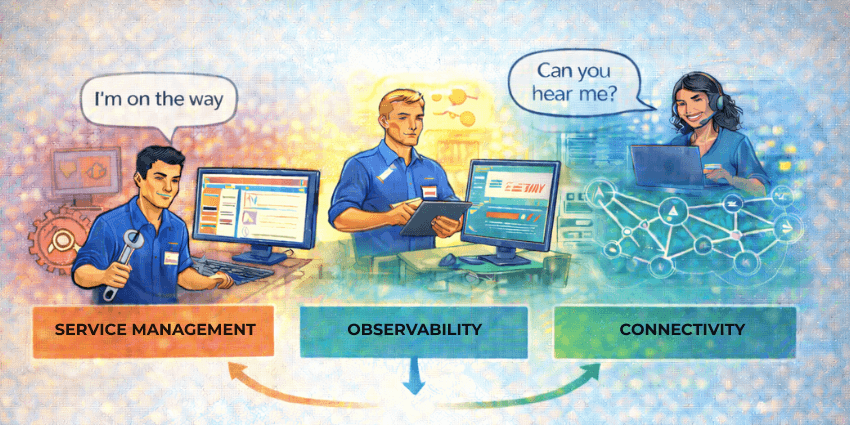
If Unified Communications (UC) is where work happens, then reliability is employee experience.
Choppy calls, frozen meetings, and “can you hear me?” are not minor annoyances. They are productivity taxes.
That is why buyers often end up comparing ITSM vs observability tools and asking where connectivity fits. Here’s what we mean by these terms.
- ITSM (IT Service Management) tools run the “help and fix” machine: incidents, service requests, and changes. They are the engines that support the tasks and workflows needed to deliver quality IT services.
- Observability tools help you understand what is happening across apps and infrastructure by collecting signals like logs and metrics. They let your infrastructure teams see the understand health, performance, and behavior of UC traffic.
- Connectivity tools keep real-time voice and video stable. They are the pathways that your data and calls move through, and it is that consistent movement which plays a key role in UC reliability.
If you’re still asking yourself which one is right for you, let’s explore which tool is right for which challenge you’re looking to solve – with some real life examples thrown in there.
Related Articles:
- Are You Ready For an Infrastructure Upgrade? How to Prepare for ITSM & Connectivity Adoption
- The Top Service Management & Connectivity Events to Attend in 2026
- How Service Management & Connectivity Tools Actually Improve Productivity
1) Objective: Migrate or Modernize UC Without a Support Meltdown
This is the “we are moving to Teams Phone/Zoom/Webex and nothing can break” goal. Enterprises are moving from legacy systems to modern cloud architecture, and service management systems are necessities in that process.
Best-fit tools: Start with ITSM plus targeted UC monitoring.
- ITSM gives you change control, ownership, and communications when issues pop up.
- UC monitoring (like Teams call quality analytics) helps you spot patterns quickly. Microsoft’s Call Quality Dashboard (CQD) can help report and investigate call and meeting quality.
What to look for:
- Change workflows that are simple enough to be used.
- A service catalog for UC moves, adds, and changes.
- A basic call-quality baseline so you can prove improvement after go-live.
What customers are saying:
ServiceNow's ITSM tools are among the market-leading products that are helping enterprises to migrate and modernize. One verified customer from India told Gartner about their experience with the platform:
- "Essential ITSM modules like project management, incident management, change management, and release management are effectively handled within the platform. An advantage is the ease of use and the speed of its web-based interface, which I have found to be very fast with no lack."
- "For our organization, it is beneficial and easy to maintain. I believe it is the best ITSM tool currently available in the market. "
2) Objective: Get Visibility Into What Users Actually Experience
If your current process is “wait for complaints,” your employee experience will always lag. Cutting-edge IT teams needs to be proactive, and that’s where observability can help.
Best-fit tools: UC observability tools plus QoE (Quality of Experience) reporting.
- UC dashboards that are designed to help admins and network engineers keep a close eye on quality and reliability.
- It’s green flag when observability tools can share reports in near real-time.
- For internet-path visibility, tools such as Cisco ThousandEyes can share best practices for monitoring Microsoft Teams.
What to look for:
- Clear user-impact views (site, building, subnet, ISP, device type).
- Alerts that point to likely causes, not just red lights.
- The ability to share evidence across UC, network, and service desk teams.
What customers are saying:
Cisco's ThousandEyes tool helped one U.S.-based insurance customer to better understand and monitor its phone connectivity. They shared their experience, saying:
- "Our company implemented ThousandEyes about 3 years ago and have been very pleased with it."
- "It provides extensive visibility into the network latency between SBCs and VOIP phones/softphones allowing use to identify issues and outages quickly."
Want to hear what analysts have to say about service management & connectivity adoption? Check out the market's top reports & research here.
3) Objective: Make Calls And Meetings Stronger Across Sites
This is where enterprise UC connectivity platforms matter most: Joining branch offices, hybrid workers, and global teams in digital pathways.
Best-fit tools: SD-WAN and cloud networking, paired with QoE monitoring.
- Tools such as VMware's SASE SD-WAN use policy-based routing across multiple WAN connections. That helps prioritize real-time apps like voice and video. This means high-priority traffic is always in the fast lane.
What to look for:
- Application prioritization for UC traffic.
- Multiple-path resilience (failover when one link degrades).
- Proof of improvement in jitter/packet loss/latency from your monitoring layer..
What customers are saying:
One reviewer from a global manufacturing firm highlighted that with HPE's Aruba Networking solution it was possible to "get up and running in minutes".