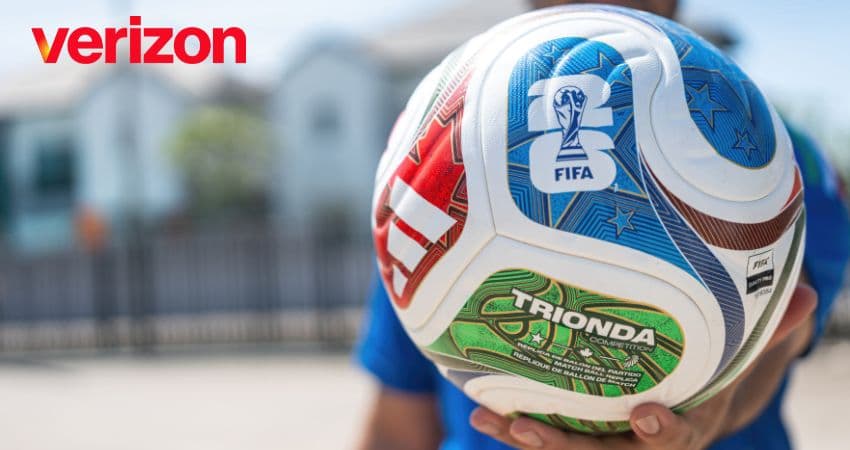
Verizon has spent more than two years building the connectivity stack behind the 2026 FIFA World Cup across host cities in the United States, Canada, and Mexico. For enterprise technology leaders, the real significance is not the sponsorship label. It is the fact that this deployment increasingly looks like a live case study in large-scale service management under pressure.
The architecture itself is serious. It combines private 5G, Fixed Wireless Access (FWA), network slicing, public 5G densification, and high-capacity fibre to support World Cup stadiums, matchday operations, and the wider tournament environment. According to Kyle Malady, CEO of Verizon Business:
“The FIFA World Cup 2026 is more than just a tournament; it’s a moment where technology and community unite.”
For UC Today readers, though, the bigger story sits elsewhere. This is really about what enterprise connectivity strategy looks like when visibility, resilience, governance, and measurable service outcomes all have to work at once. Spectators are expected to consume more than 50TB of data per match inside a single stadium. That is not just a fan traffic stat. It is a useful indicator of what happens when a global event treats connectivity as a governed service with clear performance targets, segmented workloads, incident planning, and enough capacity to avoid peak-hour collapse.
Related Articles
- How Poor IT Visibility Drives Hidden Enterprise Risk and Cost
- Why Network Failures Are Silently Breaking UC Performance
- Canva Acquires Simtheory and Ortto as It Expands Into AI and Marketing Tech
This Is Really a Service Performance Story
Enterprise teams know the pattern. When connectivity breaks under load, the fallout rarely stays with the network team. It hits collaboration quality, slows incident response, increases brownouts, and drives up hidden operational cost. Verizon’s World Cup deployment matters because it tackles that risk with a layered model enterprise buyers can recognise. In that sense, this is less about sponsorship and more about how to deliver predictable service performance during one of the biggest sporting events in the world.
The Architecture Pattern Enterprises Can Copy
Public 5G densification prevents peak-hour performance collapse
Verizon says it has added spectrum and densified coverage across FIFA World Cup 2026 stadiums. The build includes under-seat antennas, large-form antennas in upper sections, and nearly 140 small cells and temporary cell sites beyond stadium perimeters. In enterprise terms, this is capacity planning in its clearest form: design for contention before users feel the failure. In World Cup terms, it is how host city connectivity avoids buckling under matchday demand.
Private 5G turns segmentation into operational control
Verizon has separated private 5G from the public network for operational use cases such as the Lenovo Referee View body cameras. That makes this one of the more strategically interesting layers in the build. It shows how segmentation protects mission-critical workflows when delay, jitter, or competition from general fan traffic simply is not acceptable. For enterprise leaders, the parallel is obvious: when a workflow really matters, isolation is not a luxury feature. It is a control mechanism.
FWA shows how fast connectivity has become a continuity tool
5G Fixed Wireless Access supports pop-up retail, temporary operations, and back-office functions tied to FIFA World Cup 2026 activity. That mirrors a growing enterprise use case. Teams can deploy connectivity quickly at temporary sites, event locations, and branch environments where fixed-line rollout is too slow or too rigid. The value here is not novelty. It is speed, flexibility, and continuity.
Network slicing brings governance into the performance conversation
5G network slicing gives operators a way to guarantee performance for selected workloads on shared infrastructure. That is what makes it more than a technical headline. For enterprise buyers, slicing is really a governance question: which services get priority, under what conditions, and how performance is protected when demand spikes across a large, distributed environment. At World Cup scale, those questions stop being theoretical very quickly.
Fibre still anchors the whole model
The wireless story only works because a high-capacity fibre backbone carries the Broadcast Contribution Network and supports the wider service architecture across World Cup venues and media environments. One of the clearest lessons for enterprise leaders is that wireless scale still depends on a strong fixed backbone underneath it. That holds true whether the setting is a World Cup stadium, a transport hub, or a dense enterprise campus.