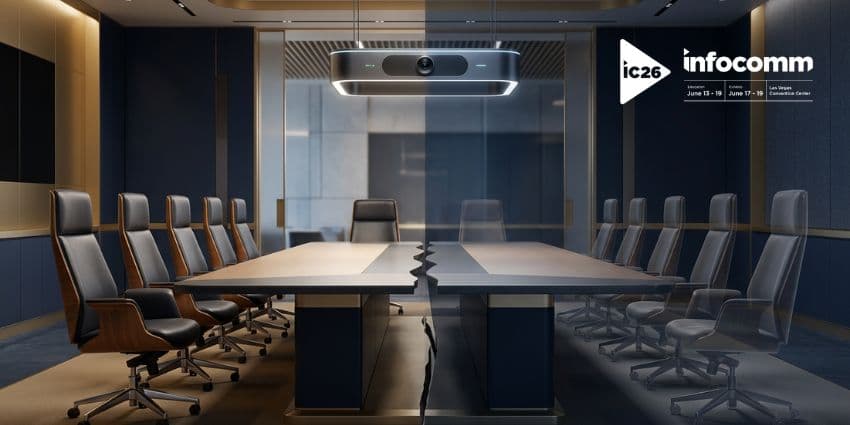
Can the Smart Meeting Room Finally Deliver on Meeting Equity? InfoComm 2026 Is Where That Question Gets Answered

InfoComm opens in Las Vegas this week with meeting equity at the centre of its collaboration agenda. After years of hardware investment, the industry is being asked to prove its own premise

5
Meeting Equity Smart Meeting Rooms InfoComm 2026
Unified Communications & CollaborationNews

Published: June 10, 2026

Marcus Law

The promise has been consistent for most of the past decade. Smart meeting rooms, equipped with intelligent cameras, beamforming microphones, and AI-assisted platforms, will close the gap between people in the room and people calling in. Remote participants will be as visible, as audible, and as engaged as those around the table.

The data suggests that has not happened yet. Barco’s meeting barometer found that 71% of employees still struggle with hybrid meetings, while one in three remote workers feels less engaged and involved than on-site colleagues.

InfoComm 2026 opens its exhibit floor on Wednesday in Las Vegas, and for the first time meeting equity is explicitly named in the show’s conferencing and collaboration programme, with dedicated sessions from Logitech, Google, Microsoft, Huddly, and AstraZeneca addressing it directly.

Meeting Equity at InfoComm 2026: Why Now

Jenn Heinold, Senior Vice President of Expositions for the Americas at AVIXA, told UC Today ahead of the show that the AI conversation at InfoComm this year is specifically about closing that gap between promise and delivery:

“The best AI is an enhancement to AV, not the other way around. The best AI is what’s making AV more proficient, efficient, and personalised.”

That framing matters. Most organisations capable of installing a smart meeting room have done so, or are in the process. The question that follows is whether that investment changed anything for the people dialling in.

Research published this year points to a consistent pattern. Remote participants in asymmetric hybrid meetings receive less speaking time, are less likely to have their ideas attributed correctly in meeting notes, and disengage faster than in-room participants. That holds regardless of room specification. Technology shapes the conditions for participation. It does not guarantee it.

Jitesh Gera, Research Manager within IDC’s UC&C continuous information service, told UC Today earlier this year:

“Over the past few years, hybrid working norms and a rapidly rising interest in AI-powered business communications have started to push organisations to redesign their workplaces and video-enable their office spaces for effective collaboration outcomes.”

What AI Has Changed in the Hardware Layer

Intelligent cameras with individual speaker tracking and multi-stream framing mean remote participants see the person speaking at consistent framing rather than a wide-angle view of a table. Beamforming microphone arrays isolate individual voices and suppress ambient noise in ways that omnidirectional conference phones could not. AI noise suppression handles keyboard noise, HVAC, and background movement as standard.

The sessions at InfoComm this week push further. “Unlock Meeting Equity with Google Meet AI and Logitech Room Solutions” covers platform interoperability, room sizing, and fleet management through a meeting equity lens. “AI Enhanced Meeting Spaces: Designing for Inclusivity, Efficiency, and Smart Automation,” featuring leaders from Logitech, Microsoft, Lenovo, Huddly, and AstraZeneca, pairs enterprise case studies with vendor positioning. The Televic session on multilingual hybrid environments covers AI-driven real-time transcription and interpretation, so participants in different languages can contribute without a human interpreter in the room.

A new addition to the show this year is the AI Accelerator, running on Tuesday before the exhibit floor opens. Heinold told UC Today the programme was built specifically to address the gap between concept and deployment:

“It’s not about AI in theory. It’s really about coming together, doing workshops and working groups on how to put AI into action. Focusing on practical frameworks and governance and really that roll-up-your-sleeves work.”

Ilya Bukshteyn, Corporate Vice President of Microsoft Teams Calling, Devices and Premium Experiences, keynotes on Wednesday. Ahead of the show he said:

“AI is creating a new era of intelligent workplaces for organisations of all kinds. The next evolution of AI is here: agentic co-workers designed to help people multiply their impact.”

The Smart Workplace Activation

The centrepiece of the show floor is the Smart Workplace environment, powered by FORTÉ at booth C5143, featuring Crestron, Legrand AV, Logitech, Q-SYS, and Sony in a fully integrated end-to-end environment. Heinold said the activation was built directly from feedback from enterprise end users:

“I don’t come to InfoComm for just one product. I come to build a space. And it would be really great if I could see more spaces I could explore at InfoComm.”

The environment runs from lobby space through individual working pods, an event and broadcast area, and a conference room, with workplace analytics running live throughout. Microsoft Teams Rooms, digital signage, and security are all integrated rather than demonstrated in isolation.

Where the Technology Stops

InfoComm has been having a version of this conversation for years. Each product cycle, the camera gets smarter, the microphone gets more directional, the platform adds a new AI layer, and the Barco data shows the same 71%.

UC Today’s hybrid meeting room technology analysis earlier this year found that organisations which redesign their meeting formats before upgrading hardware see larger engagement improvements than those that buy new equipment and change nothing else. Cameras and microphones address the technical barriers to participation. They do not make the in-room group turn to face the screen when a remote colleague speaks, or include remote participants in the conversation that happens before the meeting formally starts.

On interoperability, which has been a recurring theme across the InfoComm session programme, Heinold sees movement. She told UC Today:

“Some of the walls that have been there are definitely coming down and there’s much more openness to work together among platforms and devices.”

Whether that openness translates into certified integrations and supported workflows is the question enterprise buyers will be testing on the show floor this week.

What Defines the Buying Decisions Teams Make in 2027

Heinold’s view on what this year’s conversations will produce is direct. She told UC Today:

“2026 is the year of convergence for AV, IT, broadcast and AI. I think that’s going to be one of the biggest themes that comes out of InfoComm this year.”

For IT buyers at the show, the sessions that put enterprise customers on the stage alongside vendors are the ones most likely to produce usable data. The FORTÉ Global Lounge hosts a “Voice of the Customer: Lessons Learned on Modern Work Transformation” panel on Thursday. The ROI of Intelligent Collaboration Spaces session puts AstraZeneca on the stage as a named enterprise voice. What those organisations are measuring, and what their numbers show, is more useful than any vendor demo.

The question to ask any vendor demonstrating meeting equity features this week is not whether their camera performs better than last year’s model. It is what metrics their existing customers are using to evaluate whether equity has improved, and what those metrics are showing.

UC Today will be on the ground in Las Vegas across all three show floor days. Keep an eye on uctoday.com for show floor coverage, vendor interviews, and anything enterprise buyers need to know.

Related reading:

Meeting Equity Solutions​SPOTLIGHT: The Rise Of Smart Meeting Rooms​
Featured

Share This Post