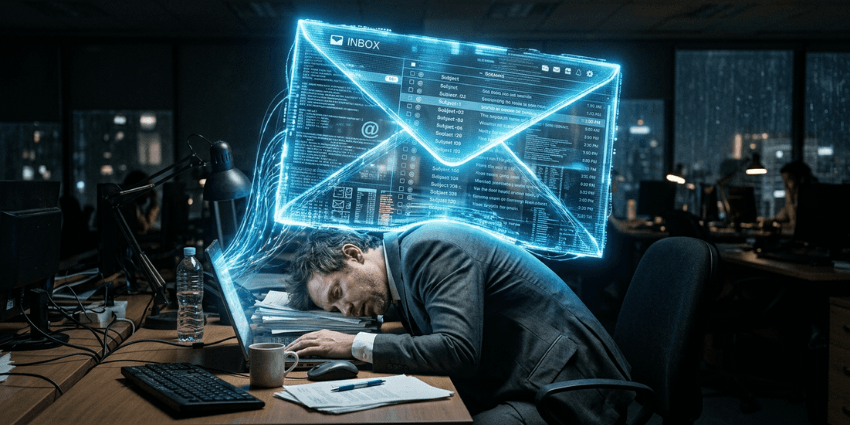
Every morning, before most people have had their coffee, millions of knowledge workers open their inboxes. Email productivity has become one of the defining challenges of modern work - yet the tools we rely on haven't fundamentally changed in decades. The promise of an AI email assistant capable of handling the cognitive load has partially arrived. But the core email limitations that make the inbox exhausting remain stubbornly intact.
Email in 2026 is not dead. It is indispensable, overloaded, and structurally behind the way modern work actually happens.
Read More:
- More AI, More Work? What the ‘Infinite Workday’ Means for UC Leaders
- Microsoft Copilot Cowork Goes Live on Frontier
It Was Built to Move Messages, Not Manage Work
When Ray Tomlinson adapted email to ARPANET in the early 1970s, the goal was straightforward: send a message from one machine to another, across organizational boundaries, without requiring the same software on both ends. By 1973, email accounted for more than half of all ARPANET traffic. The standards that followed - SMTP in 1982, RFC 822, MIME, IMAP - made the system resilient and universal.
They also locked it into a transport-storage-retrieval model that has never been updated at its core. The email limitations embedded in those protocols are not oversights - they are the foundation. IMAP has no concept of a decision, a deadline, an approval, or an obligation. Every time a worker opens a thread and asks what do I need to do here? - that inference is entirely on them.
No AI email assistant changes the underlying model.
These architectural email limitations are precisely why better email productivity was never something the protocol was built to deliver.
The Work Nobody Counts
The numbers are stark. According to Microsoft's 2025 'Rise of the Infinite Workday' study, 40% of workers check email before 6am, evening meetings are up 16%, and the average employee receives 117 emails and 153 Teams messages daily - while being interrupted roughly every two minutes. McKinsey estimates 28% of the working week is spent on email alone.
But volume isn't the deepest problem. A 2024 study in Frontiers in Psychology found it's specifically communication-related emails - the ambiguous ones, the "keeping you in the loop" threads - that drive the most strain over time. A separate study of 1,491 knowledge workers found email overload significantly predicted perceived stress, independent of message count.
The inbox has become the place where organizational ambiguity accumulates, and the email limitations of that model fall squarely on the individual worker. Workers read a thread, infer a task, reconstruct missing context, decide who owns the next move, draft a reply - and repeat across dozens of threads daily.
None of that is doing the work.
It is the overhead of translating messages into action. Any AI email assistant built on top of a thread reader reduces effort at the margins but doesn't change the equation - and no amount of smarter filtering improves email productivity if the medium still treats work as a stack of messages.
Why AI Hasn't Fixed It Yet
The tools have improved. Copilot drafts emails, summarizes threads, and suggests replies. Gmail's AI Inbox beta surfaces to-dos and matches your writing tone. An AI email assistant is now a standard pitch from both Microsoft and Google.