Let me tell you something your vendor is praying you never find out.
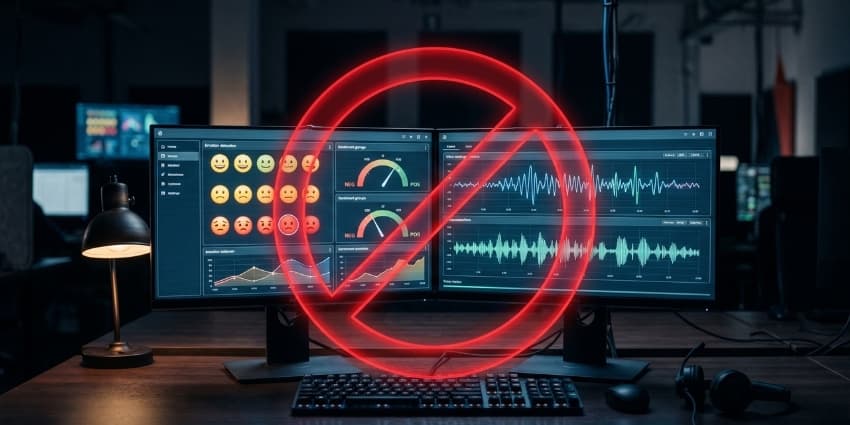
The shiny "agent wellbeing" dashboard they pitched you last quarter, the one with the emoji faces lighting up next to your call center agents' names, the one that promised to revolutionize employee engagement by reading emotional state from voice data? It's been illegal across the entire European Union for well over a year.
Not restricted. Not heavily regulated. Not subject to a voluntary code of conduct. Illegal. Banned outright. Article 5(1)(f) of the EU AI Act, in force since February 2, 2025.
And here's the really outrageous part. A stunning number of UC and contact center vendors are still selling it. Still demoing it at trade shows. Still writing it into enterprise contracts. Still, astonishingly, claiming in sales meetings that it's a competitive differentiator.
It isn't a differentiator. It's a €35 million fine waiting to land on someone's desk. And unless you're paying very close attention, that desk might be yours.
The truth is, emotion AI at work is no longer a product category in Europe. It's a violation of fundamental rights. That's not my opinion. That's the law.
The Dirty Little Secret the Enterprise Software Industry Doesn't Want You Reading
For the best part of a decade, one pitch has run through the enterprise AI market. It went something like this. Managers could finally see the unseeable. The inner life of the workforce could be measured. A well-designed algorithm could tell a team leader how their people were really feeling, without anyone ever actually having to, you know, talk to them.
It was always a creepy proposition. It implied the best way to understand a human being was to stop speaking with them and start analyzing their face. But it sold. Boy, did it sell. Sentiment overlays on video calls. Vocal stress analysis on agent lines. Wearables that scored employee focus from heart rate variability. Facial expression AI that graded customer service reps on how sincerely they smiled.
The European Union has now written into law the view that this was never a product category at all. It was a breach of human dignity at work, dressed up in dashboard design.
You can argue with the reasoning. You cannot argue with the fine.
What the EU Actually Banned, and Why Your Compliance Team Should Already Be Panicking
Here is what Article 5(1)(f) actually says, in plain English. Any AI system that infers the emotions of a person in a workplace or educational setting is prohibited. Full stop. The only exceptions are narrow carve-outs for medical or safety purposes, like detecting driver fatigue in a logistics fleet.
The ban applies to providers, meaning the vendor selling the software. It applies to deployers, meaning the employer using it. And crucially, it applies regardless of where the vendor is headquartered, so long as the system touches people in the EU.
Is your contact center platform taking calls from Hamburg or Madrid? You're in scope.
Does your wearables program include operations in Dublin or Milan? You're in scope.
Is your collaboration suite used by employees sitting anywhere in the European Economic Area? You're in scope. And so is your vendor.
"Seven percent of global turnover. Whichever is higher. That's the fine tier reserved for the very worst AI practices the European Union can imagine. And workplace emotion recognition sits right there, next to social scoring and subliminal manipulation. Let that sink in."
The Date Every CIO Should Have Had Circled in Red Ink
February 2, 2025. That's the day Article 5 came into force.
That was more than a year ago. A year in which vendors could have quietly ripped the feature out of European builds. A year in which legal teams could have written client advisories. A year in which buyers could have been told, honestly, that a chunk of what they were paying for was now unlawful.
Instead, much of the industry has responded with a masterclass in looking the other way. No press releases. No product recalls. No "important update regarding your deployment" emails. Just a quiet hope that nobody gets around to enforcing it until August 2026, when the rest of the AI Act rolls in and the noise gets louder.
Hope, I'm afraid, is not a compliance strategy.
The European Commission's November 2025 review of the AI Act specifically declined to soften the prohibited practices list. The bans are staying. The Irish Workplace Relations Commission, of all regulators, will enforce the workplace emotion recognition prohibition in Ireland. France's CNIL is handling it domestically. Complaints are being filed. The first major enforcement case is expected this year.
Your vendor has had 14 months. What have they actually done about it?
Emotion AI vs Sentiment Analysis: The Distinction That Will Decide Who Gets Fined
This is where smart buyers need to get very precise, very fast.
The AI Act bans the inference of emotions from biometric data. That's voice, face, gait, physiological signal, keystroke rhythm. Anything where the system reads a body and draws an emotional conclusion.
It does not ban the detection of readily apparent physical states. A tool that notes a person is smiling, without drawing a conclusion about whether they're happy, is lawful. A tool that concludes they're happy is not.
It also does not ban text-only sentiment analysis. Scanning written support tickets or chat logs for positive and negative tone is not an emotion recognition system under the Act, because it doesn't use biometric data. That distinction alone is going to decide which features survive in European product builds and which get quietly buried.
Here's a useful test. If your vendor is selling you "voice-based agent mood detection," that's a banned feature. If your vendor is selling you "written ticket sentiment scoring," that's probably fine. If your vendor is selling you "facial expression engagement analytics" on Teams calls, that's a banned feature. If your vendor can't tell you which category their product falls into, find a better vendor.
"If your vendor can't explain, in writing, whether their product infers emotion from biometric data, you already have your answer. And it isn't the one you want."
The Contact Center Time Bomb Nobody in UC Wants to Defuse
Brace yourself, because this is where it gets genuinely messy for UC Today readers.
The AI Act splits emotion recognition into two buckets, and they sit in dramatically different legal boxes.
Emotion inference applied to your employees: prohibited. Seven percent of global turnover fine tier. Article 5(1)(f).
Emotion inference applied to your customers: high-risk, not banned. Permitted, but subject to extensive compliance requirements coming fully into effect in August 2026.
Now picture the average modern contact center deployment. A single voice analytics engine sits on the call. It listens to both parties. It produces outputs for both. The vendor probably sold it on a combined pitch of "customer sentiment insights" and "agent coaching and wellbeing monitoring."
In any European deployment, that architecture is now split down the middle by the AI Act. The customer-facing half has to be fully compliant by August 2026. The agent-facing half has been outright illegal since last February.
Which means, practically, a huge swath of contact center software deployed across European operations needs to be reconfigured, restricted to text-only features, or switched off entirely on the agent side. Ask your vendor, today, which side of that split their product sits on. Ask them to put the answer in writing. If you don't get an answer, or the answer is evasive, you already know what you're dealing with.
Wearables, Webcams, and the Hidden Surveillance You Bought By Accident
The ban reaches much further than the call center.
Any workplace wearable that infers stress, focus, or emotional state from heart rate variability, galvanic skin response, or brain activity is, if used to monitor employees, a prohibited system. Some of the more ambitious frontline workforce experiments running right now are sailing directly at this legal wall.
Collaboration platforms are exposed too, and this is where the law actually makes sense for once.
Meeting transcripts? Completely fine. AI-generated summaries of what was said in a call? Fine. Action items, decisions captured, follow-ups flagged, searchable archives of your team's standups? All fine. And if you understand why, you understand the entire logic of the AI Act.
Here it is in one sentence. The European Union did not ban AI in the workplace. It banned one very specific thing, which is the inference of a person's internal emotional state from their biometric data. That's it. That's the whole prohibition. Everything else survives.
A meeting transcript doesn't infer anything about anyone's feelings. It takes audio and converts it into text. It captures words, not emotions. It records what was said, not how the speaker felt when saying it. A transcript of a product review meeting contains the product decisions, not a psychological profile of the people making them. That's a legitimate productivity tool. That's what note-taking software is supposed to do, and the AI Act has zero problem with it.
"A transcript captures words. An emotion recognition system captures feelings. One is a productivity tool. The other is workplace surveillance dressed up to look like a productivity tool. The EU AI Act is perfectly capable of telling the difference. Your vendor should be too."
The same logic runs through the rest of the stack. Text-only sentiment analysis, scanning written Slack messages or support tickets for positive and negative tone, is not a prohibited system. It doesn't use biometric data. It processes text. AI that summarizes an email thread, drafts a reply, flags urgent messages, or pulls out key themes from written customer feedback is all lawful. None of it reads a human body to deduce a human feeling.
Where the line gets crossed is the moment a tool adds a layer on top that analyzes the speaker's voice to decide they sounded stressed, or reads their face on video to score how engaged they looked, or tracks their keystroke rhythm to infer frustration. Now you've left the world of productivity software and entered the world of Article 5(1)(f). One feature is a meeting assistant. The other is a surveillance system wearing a meeting assistant's costume.
This is why a handful of enterprise vendors have very quietly removed sentiment and engagement overlays from European builds over the past 18 months, while leaving transcription and summarization features entirely alone. They know exactly where the line is. The question is whether your vendor has actually drawn it, or is still hoping nobody notices that their "engagement analytics" module does precisely what Brussels has forbidden.
Some are betting that what they sell is "expression detection" rather than "emotion inference" and hoping regulators split the hair in their favor. The Commission's guidelines explicitly instruct regulators to interpret the ban broadly, not narrowly. I wouldn't want to be the General Counsel making that argument in front of CNIL.
"This isn't a small technical provision. It's the European Union telling an entire software industry that one of its favorite product pitches is a human rights violation. The vendors still pretending otherwise are running out of road."
The Fines That Could Wipe Out a Quarter of Global Revenue
Three penalty tiers apply under the AI Act.
Breach of a prohibited practice, including workplace emotion recognition: up to €35 million or 7% of global annual turnover, whichever is higher.
Breach of high-risk AI obligations: up to €15 million or 3% of global turnover.
Providing incorrect information to regulators: up to €7.5 million or 1%.
And here's the kicker. Because emotion recognition typically processes biometric data, which is special category data under GDPR, most violations will also trigger a parallel GDPR finding. Fines can theoretically stack to 11% of global turnover. For a large platform vendor, that's a quarter of a year's revenue, gone.
The ICO's decision against Serco Leisure in 2024, ordering the company to stop using facial and fingerprint scanning for staff attendance across 38 sites, gives you a fair indication of the appetite data protection authorities have developed for workplace biometric cases. And that was before the AI Act even came into force.
What You Need to Do Before Your Next Board Meeting
If your organization runs UC, CX, or employee experience software across any European operation, here's your week one checklist.
One. Ask every single vendor, in writing, whether their product infers employee emotional state from voice, facial, physiological, or behavioral biometric data. Direct question. Written answer. No waffle.
Two. Ask whether those features are enabled by default in European deployments and whether they can be disabled at tenant level. If they can't be disabled, that's a red flag.
Three. Ask for the vendor's written compliance assessment against Article 5(1)(f) of the AI Act. If they shrug, you now know the risk sits with you.
Four. Separate customer-side and agent-side analytics in contract and configuration. Different legal worlds. Don't let the vendor collapse them in the sales pitch.
Five. Audit your wearables and workforce management stack urgently. The frontline tech layer has grown fast and quietly, and some of it is inferring far more about worker internal states than buyers realized at point of sale.
Six. Loop in your works council or employee representatives now. Consultation before deployment is what regulators expect, and it's the only posture that survives scrutiny when the first enforcement case lands.
The Reckoning Is Coming. The Only Question Is Who Gets Made an Example Of
Here's my honest read on where this is going.
There will be a first major enforcement case. It will happen this year. It will almost certainly involve a vendor most UC Today readers recognize. And when it lands, every buyer who signed a contract without asking the hard questions will be dragged into a procurement review that they could have avoided with one email and one written answer.
The vendors who built their product decks around emotion AI are, as of this year, in a very quiet panic. The regulators are, politely, sharpening their tools. The buyers who signed the contracts are, by and large, entirely unaware of it.
You don't want to be the one who finds out the hard way. Ask the questions this week. Get the answers in writing. Because when the fine lands, "my vendor didn't tell me" won't be a defense.
It'll be exhibit A.
Sources: European Commission, Guidelines on Prohibited AI Practices (February 2025); EU AI Act Article 5(1)(f) and Recital 44; ICO Serco Leisure enforcement (2024); OECD Algorithmic Management in the Workplace (2025); IAPP Biometrics in the EU (2025).