
A cluster of lawsuits against Otter.ai has pushed third-party AI notetakers to the top of every IT risk register, and Microsoft, Zoom and Google are quietly rewriting their meeting platforms in response.
Microsoft Teams Introduces Default Bot Detection
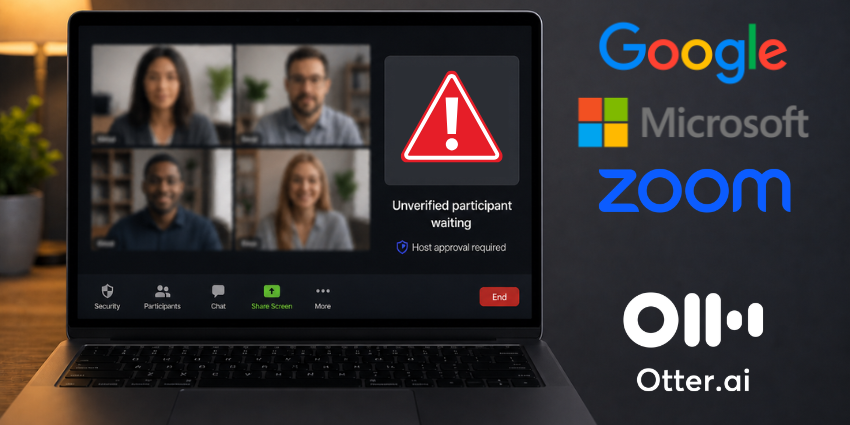
The most visible move comes from Redmond. On 13 March 2026, Microsoft published Message Center notice MC1251206, announcing that Microsoft Teams will detect external third-party meeting bots, label them “Unverified” in the meeting lobby, and require the organizer to admit them explicitly. The feature is on by default.
Targeted Release is scheduled for mid-May 2026, with general availability for worldwide and GCC tenants in early to mid-June.
“Bots may access meetings without the knowledge or consent of the meeting organizer or the hosting tenant, which can create data security, privacy, and compliance risks.”
– Microsoft 365 Message Center notice MC1251206, 13 March 2026
The practical consequence is that any third-party notetaker, Otter included, will need to show its credentials at the door. Admins can also set policy to auto-block external bots at the tenant level.
Zoom AI Companion Already Requires Host Consent
Zoom has been further along this path. Its AI Companion requires host or co-host initiation, shows a visible sparkle indicator when active, and prompts individual participants to agree. Administrator controls allow Zoom AI Companion to be disabled in third-party meetings.
Zoom chief executive Eric Yuan told Fortune in October 2024 that the company was “the first vendor” to commit publicly to not using customer meeting content to train AI models without explicit consent, a position Zoom has held since an August 2023 terms of service controversy.
Google Meet and Tenant-level Controls
Google Meet’s “Take notes for me” feature, powered by Gemini, similarly requires a host or co-host to initiate it. An on-screen pencil icon and banner appear. Google Workspace administrators can gate the feature by organizational unit or group. Google says the captured data stays within the customer tenant and is not used for advertising training.
Native vs Standalone: The UC Split
The practical effect is that UC platforms are splitting cleanly into two camps. Native AI, offered by the host platform itself, is being re-architected to pass the consent test. Standalone AI bots, which sit outside the platform and join as guests, are being pushed further into the cold.
Irwin Lazar, principal analyst at Metrigy, put the competitive logic succinctly:
“Providing these kinds of capabilities at no additional charge demonstrates lower total cost of ownership compared to Microsoft, and eliminates the need for its customers to purchase third-party meeting recording and transcribing apps like Otter and Fireflies.”
– Irwin Lazar, principal analyst, Metrigy
Institutions Reinforce the Divide
Institutions are reinforcing the split on their own. The University of Washington’s IT office blocked Read AI from Zoom and Teams integration on 21 January 2025. Chapman University followed on 13 August. UC Riverside moved on 7 October, restricting all non-native AI bots across its video estate.
The Otter Hearing as Inflection Point
All of this sits against the backdrop of In re Otter.AI Privacy Litigation, a consolidated federal class action in the Northern District of California. Otter’s motion-to-dismiss hearing is scheduled for 20 May 2026.
A ruling against Otter, or even a narrow decision allowing the case to proceed to discovery, would sharpen the compliance calculus for every buyer of a third-party notetaker. Fireflies.ai, hit with its own BIPA class actions in December 2025 and early 2026, faces a similar test.
What UC Buyers Should Ask Now
For UC decision-makers, three practical questions now dominate.
Is consent handled at the platform level or left to the end user? Otter’s terms tell the account-holder to “make sure you have the necessary permissions,” a structure the plaintiffs argue fails in all-party consent states.
Are external bots allowed to auto-join, or must they be admitted? Microsoft’s forthcoming default answers that question in Teams. Zoom and Google have already answered it on their own platforms.
Is captured data used to train vendor models, and if so, under what consent? Every vendor now has to show its working.
The direction of travel is settled, even if the law is not. Meeting bots no longer walk in unannounced. The question the Otter ruling will answer is whether the ones that already did are liable for it.
Find Part 1 & Part 2 of this series here:
- Otter.ai on Trial, and the AI Notetaker Industry with it
- When the Meeting Ended, Otter Kept Listening
Sources
- Sergiu Gatlan, “Microsoft Teams will tag third-party bots in meeting lobbies” – Bleeping Computer
- Tony Redmond, “Third-Party Recording Bots Blocked by Teams Meetings” – Office 365 IT Pros, 16 March 2026
- Jeremy Kahn interview with Eric Yuan – Fortune, 9 October 2024
- Google Workspace admin help, “Let Google Meet AI take notes for my users” – Google Support
- University of Washington IT – Read AI deactivation notice
- Chapman University IS&T – Security Notice Regarding Read AI
- Inside UCR – UCR limits AI bots to comply with security measures
- In re Otter.AI Privacy Litigation, 5:25-cv-06911 – CourtListener docket