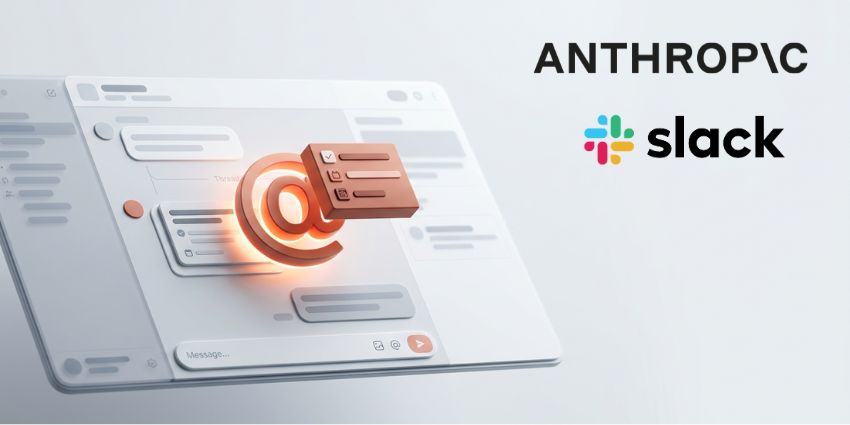

Tag @Claude in a Slack channel and it takes on the job itself. It works through the steps with the tools it can reach, then posts the result back to the thread. That is Claude Tag, Anthropic’s rebuilt Slack integration, and it behaves less like a chatbot you query than a colleague you delegate to. The shift matters for anyone running project and task management. The agent stops waiting in a side window for prompts and starts working inside the channel where tasks already get assigned.
The product went live on 23 June in beta for Claude Enterprise and Team customers. It runs on Claude Opus 4.8, the model Anthropic released a month earlier. It replaces the existing Claude in Slack app, which retires on 3 August, leaving administrators a 30-day window to opt in and migrate.
For Cat Wu, Anthropic’s head of product for Claude Code, the change is less about new capability than about the gesture that reaches it.
“A lot of the capabilities did exist, but the form factor of being able to tag it the same way that you would a coworker is really powerful.”
Wu uses it to route her Gmail alerts into Slack threads. The agent flags when someone important emails her, then drops the message into the channel where she can respond.
What Changes for Project and Task Management Workflows
Four properties separate Claude Tag from the integration it replaces, and each one maps onto a familiar problem in coordinated work.
The first is that it is multiplayer. Within a channel, one Claude serves everyone. Anyone can see what it is working on and pick up a task a colleague started, without re-briefing it. That closes the handoff gap, where work stalls the moment the owner logs off or goes on leave. The context belongs to the channel, not to one person.
The second is memory. As Claude follows a channel, it learns the team’s work, its vocabulary, and its decisions. People no longer explain a project from scratch each time they hand off a task. With an administrator’s permission it can pull context from other channels and connected data sources, though it does not report from private channels.
The third is asynchronous execution, and this one reframes the category. You set Claude a task and return to your own priorities while it works. It can even schedule work for itself, running a project over hours or days before returning to the thread with what it produced. Task tracking records the state of work. This does the work, then reports the state back.
The fourth is initiative. With ambient mode switched on, Claude does not wait to be tagged. It monitors its channels, surfaces information it judges relevant, and chases threads or tasks that have gone quiet. That marks a real step up in autonomy. Anthropic is candid that teams should keep ambient mode off until they understand how it behaves, since it lets the agent jump into a conversation unasked.
Anthropic’s own usage is the strongest evidence that the model works. An internal version of Claude Tag now writes 65% of the product team’s code, including much of what built Claude Tag itself. The pattern has spread past engineering, into chasing product metrics, clearing support tickets, and tracing awkward bugs.
The Governance and Billing Detail Buyers Will Ask About
Setting up Claude Tag is an administrator’s job. An admin pairs it with a workspace, connects the tools and data it can reach, sets spending limits, and picks the channels it runs in. Each Claude identity stays scoped to the channels an admin defines. So an instance set up for legal work cannot seed its memory into an engineering channel. That control is what makes departmental deployment workable across teams handling different levels of sensitivity.
Billing follows usage rather than headcount, so channel work bills to the organisation while direct messages run on the individual’s own Claude account. Anthropic is offering introductory credits to soften the trial: $25,000 for eligible Enterprise organisations and $2,500 for Team customers. Both apply to channel usage rather than DMs. Admins can view, edit, and delete what Claude remembers from a central audit console. Slack conversations follow existing Slack retention policies, and once the integration is disconnected Anthropic removes the data from its systems within 30 days.
The token question is the one to watch. Continuous, asynchronous monitoring changes the consumption profile in a way no request-and-response bot ever did. Handing one vendor’s AI persistent access to institutional context also raises the switching cost over time. That is the trade buyers weigh against the productivity case.
A Contested Channel as Rivals Race to Own the Workflow
Claude Tag lands in the middle of a fight over the Slack channel as the place coordinated work happens. Slack now bills itself as an agentic operating system. Salesforce added more than 30 agentic capabilities to Slackbot in March. OpenAI introduced Workspace Agents in April, spanning Slack, Google Drive, Microsoft apps, Salesforce, and Notion. Perplexity shipped an enterprise agent with direct Slack integration too. Rob Seaman, EVP and GM of Slack, says the channel is where the contest is settled.
Slack is the only layer in the AI stack where teams work together. Bringing Claude Tag into Slack is about making AI multiplayer. Instead of a private back-and-forth, Claude Tag shows up in the open, in your channels, alongside your team, where it can see the real context of how your organization works.
The wrinkle is that several of these rivals overlap rather than line up neatly. Salesforce owns Slack, yet Claude Tag now competes for the same channel real estate as Slackbot and Agentforce. That gives buyers a crowded field of agents promising much the same thing in the same window. Whichever one becomes the default presence in the channel earns the context and the habit that make it hard to displace later.
Why Claude Tag Reads as a Category Shift, Not One Integration
For anyone running project and task management, the through-line is one the category has traced all year. Platforms have moved from task tracking toward coordinated AI-assisted work. monday.com has rebuilt around native agents, Asana ships AI Teammates, and ClickUp runs Autopilot and Ambient Agents. Claude Tag makes the same argument from the model-vendor side that Asana makes from the platform side. The value sits in collaborative work, not individual speed. Victoria Chin, Senior Director of Product Strategy for AI at Asana, says as much.
There are many useful AI platforms making individuals faster, but not as many actually make entire teams or organisations more effective.
The same logic runs through how both products handle memory. A copilot starts fresh with whoever prompts it, while here the team becomes the unit that benefits. Chin frames the difference in those terms.
They have shared memory where an entire team can benefit, not just the single person who prompted them.
That is the capability Claude Tag carries into Slack, and it is why the launch reads as a category development rather than a single integration. Anthropic plans to extend Tag to Microsoft Teams, email, and other project management tools in the coming weeks. Once it leaves Slack’s walls, it becomes a cross-platform agent that works wherever a team coordinates. That is the point at which a Slack launch becomes a project management story.