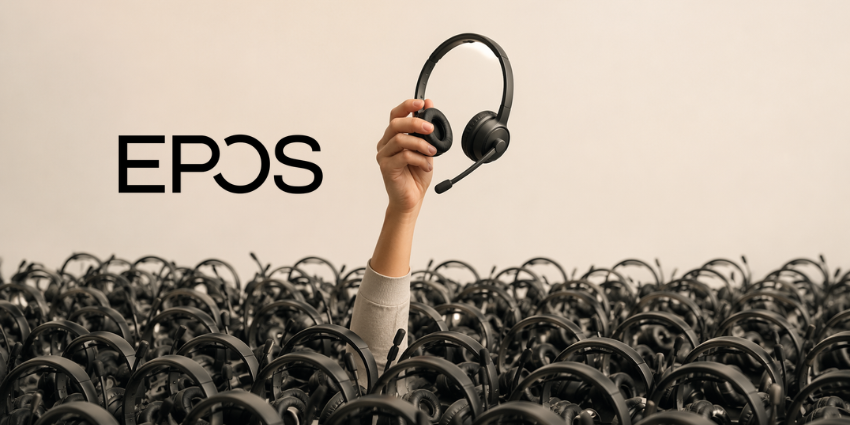

The launch of a redesigned workplace headset tends to draw attention. In particular, the flashy features: better noise cancellation, smarter AI, and a more comfortable fit. But for enterprises looking to enhance their AV capabilities, there’s an often-overlooked issue: how will these devices be managed?
When enterprise buyers start evaluating the practicality of hundreds of AV devices, each needing firmware updates and security oversight for years to come, there is a clear missing link. That is where an AV management solution goes from easily overlooked to quietly essential.
Read More:
In this article, we’ll be looking at the recent launch of a new EPOS headset – and how the company is quietly unlocking value within enterprise AV with its EPOS Manager tool.
TL;DR: A Different Way to Read the EPOS IMPACT 1000 Launch
- EPOS’s new workplace headset looks to bring real improvements for users.
- For buyers thinking at scale, a more useful question is what happens after the headset is deployed.
- EPOS Manager, the company’s device management platform, already has a track record that speaks to that question.
- A real-world deployment shows a 1,000-plus device rollout saving roughly 250 work hours per update cycle.
- Independent analysts see the wider AV market moving the same way: toward centralized management as a genuine source of value.
What Is EPOS’s New Workplace Headset?
The newly upgraded EPOS IMPACT 1000 launch went live recently, replacing a ten-variant range with five streamlined options. EPOS’s central claim is word accuracy above 99 out of 100, enabling AI-directed voice commands and transcripts to be recorded near-perfectly.
Søren Holm Printz, VP of Strategy & Product Management at EPOS, said: “The IMPACT 1000 has been in the market for three years, and in that time, it has consistently proven through rigorous, unbiased external testing that it is truly best-in-class. For professionals who refuse to compromise on precision speech clarity, this headset remains the gold standard.”
But back to the central question: how are devices like this being managed?
Why Does Device Management Deserve Equal Billing?
A single workplace headset performing beautifully is a nice outcome for one employee. A thousand headsets performing consistently, staying updated, and remaining secure over several years is a harder achievement, and it rarely comes from the hardware alone.
This is where EPOS Manager enters the picture. It is a cloud-based device management platform, built on Microsoft Azure, giving IT centralized visibility over every EPOS headset in the estate, through asset management, update management, and configuration management.
What Can EPOS Manager Do That the Headset Itself Cannot?
EPOS Manager gives IT centralized visibility and control across an EPOS headset fleet, rather than depending on each employee to install updates manually.
It looks to bring together the practical tasks that become harder as a headset estate grows: identifying active and inactive devices, maintaining current firmware, scheduling or forcing critical updates, and applying configuration settings across selected users or the wider organization.
The management tool allows IT teams to tailor settings for different employees while maintaining a consistent baseline, helping them balance user experience, operational control, and compliance requirements without needing to manage each device individually.
Unlike the headset’s audio features, these capabilities sit in the management platform behind the device. That makes them less visible in a product launch, even though they can have a greater impact on IT efficiency at scale.
Key Takeaways
- Device management often shapes security and stability at fleet scale as much as individual device performance.
- EPOS Manager’s asset, update, and configuration functions are the tools IT teams rely on day to day.
- Buyers ask vendors how updates are pushed and monitored across a fleet, alongside how the device itself performs.
What Is The Impact Of An EPOS Manager Deployment?
Sympany, a Swiss health insurer, offers a useful, grounded example of EPOS Manager at genuine enterprise scale.
Its contact center runs on a virtualized desktop setup that made simple headset updates difficult, a challenge that peaked during the pandemic.
EPOS Manager was able to centrally administer more than 1,000 headsets. This saved an estimated 250 work hours per firmware update cycle, roughly USD $11,000 in time costs.
Alexander Schmidt, IT Manager at Sympany, said:
“EPOS Manager is a delight. We have immensely benefited from the central administration, saving a lot of time and effort.”
Key Takeaways
- EPOS Manager can save hundreds of work hours per update cycle.
- AV management systems can replace repetitive manual work for AV teams.
Where Is the AV Management Market Heading, According to Independent Analysts?
Much of the analyst commentary coming out of the AV space this year points to the same idea: centralized, AI-assisted device management is becoming a genuine source of differentiation, not just an operational nice-to-have.
Irwin Lazar, Principal Analyst at Metrigy, told UC Today at InfoComm 2026:
“We saw AI designed to improve operational use cases: room layout and design, room management, troubleshooting, data and analytics, room configuration management, and so on… companies are really starting to realize that this idea of having islands of data for AI is not really sustainable long term.”
That “islands of data” problem is the kind of challenge that AV management tools such as EPOS Manager are built to address. A workplace headset performing well but reporting its status nowhere is, in a smaller way, the isolated device Lazar describes.
Key Takeaways
- Analyst commentary points to the market moving steadily toward centralized device and room management.
- The “islands of data” problem is the gap that a unified platform like EPOS Manager is designed to close.
- Worth weighing a vendor’s management platform as seriously as its device lineup for long-term value.
Seen this way, the IMPACT 1000 launch is an interesting example: a well-designed device, sitting atop infrastructure quietly doing longer-lasting work.
Which platforms are setting the standard for AV device management at scale? The UC Awards 2026 recognize the vendors demonstrating it.
Final Takeaway: What Should Enterprise Buyers Actually Weigh?
The IMPACT 1000’s update, and its AI-assisted voice pickup will genuinely matter to people wearing it every day. That is worth recognizing. But for IT leaders, there is a second, quieter story worth just as much consideration. EPOS Manager, the platform running underneath AV devices, already carries a proven record at scale.
For any buying committee weighing headsets, it is worth asking not only how good a device sounds, but who manages a thousand of them once deployed.
Ready to see how the market’s leading AV management platforms measure up? Discover the Best AV Platform, Management & Analytics category at the UC Awards 2026.
Find Out More About The Best AV Platform, Management & Analytics Award
FAQs
What is the EPOS IMPACT 1000?
The EPOS IMPACT 1000 is an upgraded workplace headset launched June 9, 2026, built around AI-driven voice pickup and a cognitive load framework called BrainAdapt.
What is EPOS Manager?
EPOS Manager is a cloud-based device management platform that lets IT remotely monitor EPOS headsets, push updates, and configure settings across a fleet.
How many devices can EPOS Manager handle at once?
One end-user, Sympany, uses EPOS Manager to administer more than 1,000 EPOS headsets. This saved them an estimated 250 work hours per update cycle.
How does EPOS Manager fit into existing IT infrastructure?
EPOS Manager runs on Microsoft Azure and works alongside the EPOS Connect app on end-user devices, giving IT centralized control without requiring a separate on-premises system. Data in transit and in storage is encrypted, so the platform can sit within an existing security framework rather than adding a new one.
Why might device management matter as much as headset features?
A single headset's performance affects one user, while unmanaged firmware across thousands can create risk over time. Centralized management helps keep a fleet secure and consistent.
About the Author
Sean Nolan is a Technology Journalist at UC Today. He has experience reporting on software that impacts employee experience, enterprise security, and workplace management. Connect with Sean on LinkedIn.