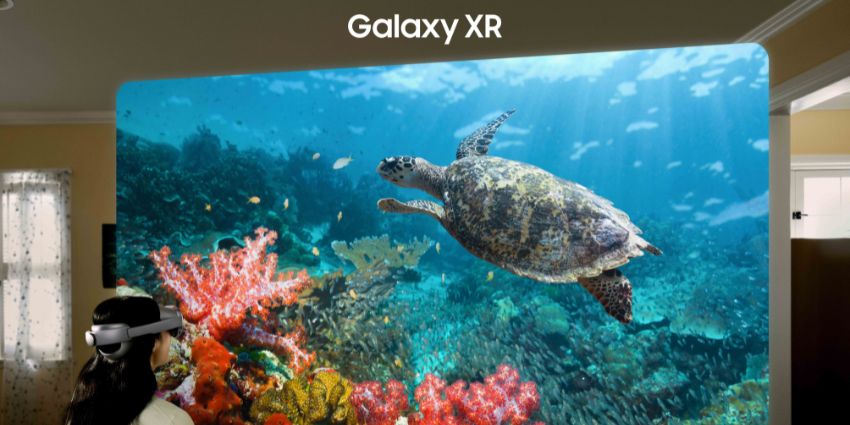

Samsung Galaxy XR enterprise adoption has moved beyond the launch-day question of whether Android could compete with Apple Vision Pro. Ten months after Samsung, Google, and Qualcomm introduced the $1,799 headset, the more important question for B2B buyers is whether Galaxy XR has become a credible enterprise XR system: secure enough for IT, practical enough for users, and useful enough to justify more than a small innovation pilot.
The answer is more encouraging than it was at launch, but it is not uncomplicated. Samsung has addressed one of enterprise XR’s most persistent weaknesses, device management, through Android Enterprise and Knox support. It has also put the device into a real healthcare environment through its blood donation initiative with Abbott. Yet comfort, price, limited published outcome data, and a still-maturing application ecosystem mean Galaxy XR remains a premium bet rather than an automatic procurement choice.
TL;DR — Galaxy XR Ten Months On
- Enterprise readiness has improved: Android Enterprise, Samsung Knox, zero-touch enrollment, managed apps, and remote lock or wipe controls now give IT teams a more familiar deployment path.
- The ecosystem is the differentiator: Galaxy XR combines Android XR, Gemini, Qualcomm hardware, and enterprise mobility controls in a way few XR platforms can match.
- Healthcare provides early proof of practicality: Samsung and Abbott have deployed Galaxy XR in a blood donation setting where hygiene, supervision, and simple interaction matter.
- The hardware trade-offs remain: $1,799 pricing, comfort variability, a tethered external battery, and optional controllers still limit large-scale everyday use.
- Verdict: Galaxy XR is now a credible enterprise pilot device, particularly for Android-led organizations. It still needs repeatable productivity evidence before it becomes a standard workplace endpoint.
Related Articles
- Samsung and Google Just Dropped Galaxy XR: Android’s Big Leap Into Mixed Reality
- Galaxy XR’s Most Unexpected Enterprise Use Case? The Blood Donation Clinic
- The Business Case for the Galaxy XR: Specs, Software, ROI
The Enterprise Story Is No Longer Just Hardware
At launch, Galaxy XR was a premium Android XR headset with strong displays, Gemini integration, and a lower price than Apple Vision Pro. Since then, Samsung’s more important work has been building the management and security layer enterprise buyers require before scaling a device fleet.
Galaxy XR launched in October 2025 at $1,799, with dual 4K micro-OLED displays, the Snapdragon XR2+ Gen 2 platform, eye and hand tracking, Wi-Fi 7, and an external battery rated for around two to two-and-a-half hours of active use. At roughly half the launch price of Apple Vision Pro, it immediately created a more plausible route for organizations wanting to test premium mixed reality without limiting a pilot to a handful of users.
But high-resolution displays and Gemini are not enough to make a headset enterprise-ready. The key post-launch update came in April 2026, when Samsung added Android Enterprise support. That matters because it brings XR closer to the way IT teams already manage Android phones, tablets, and dedicated devices.
Samsung’s enterprise update includes Android zero-touch enrollment, QR setup, dedicated-device and fully managed modes, Managed Google Play deployment, network configuration, password policies, remote lock, and remote wipe. Samsung Knox adds its familiar hardware-backed security layer, while Android XR is set to receive security updates for up to five years from the October 2025 launch.
James Choi, EVP and Head of the XR R&D Team at Samsung Electronics, positioned the update as more than a device refresh:
“Our vision for XR extends beyond hardware — it’s about building a secure, scalable ecosystem informed by our users. With Android Enterprise support and ongoing platform upgrades, Galaxy XR demonstrates how real-world use cases across work, discovery and play influence our direction.”
That is the right framing. The strategic value of Galaxy XR is not that it is another headset. It is that Samsung, Google, and Qualcomm are attempting to make spatial computing fit into a familiar enterprise mobility model.
Why Android Enterprise Changes the Buyer Conversation
Most enterprise XR projects struggle at the point where a compelling demo has to become a managed endpoint. Who enrolls the device? Which apps can be installed? What happens if a headset is lost? How is sensitive content removed? Can a shared device be restricted to a single workflow?
Galaxy XR now has a more complete answer than many standalone XR products. Android Enterprise’s expansion to Android XR creates standardized management controls, while Samsung Knox provides a recognized security brand for regulated buyers. David Still, VP in charge of Product and Engineering at Android Enterprise, made the wider significance clear:
“The expansion of Android Enterprise to Android XR brings the trusted security and management framework IT professionals rely on for millions of Android devices to the new era of spatial computing, starting with Samsung Galaxy XR.”
This does not remove deployment complexity. Shared headset hygiene, user authentication, support processes, physical storage, prescription lens requirements, and content governance still need to be designed by the customer. But it reduces the number of completely new operational processes IT must invent.
For Android-first organizations, especially those already using Knox Manage or Android Enterprise, that familiarity is a meaningful advantage. Galaxy XR can become part of the existing endpoint strategy rather than a separate XR experiment sitting outside it.
The Blood Donation Deployment Is More Important Than It Looks
Galaxy XR’s most useful enterprise proof point so far may not be a virtual boardroom or CAD review. It is a blood donation clinic.
Samsung’s collaboration with Abbott and the Korean Red Cross used Galaxy XR to give blood donors a gaze-controlled meditation experience during donation. On the surface, this sounds like a consumer wellness demonstration. In practice, it tests several things enterprise XR deployments often get wrong: simple interaction, hygiene, real-world supervision, comfort, and the ability to retain user awareness of the physical environment.
The experience was deliberately low-friction. Donors interacted through gaze rather than controllers or gestures, spending three to five minutes in a Zen garden-style environment. That matters because enterprise XR often fails when interaction demands more learning than the task itself.
“[Galaxy XR] is well-suited for healthcare settings, allowing medical staff to monitor donors more easily while helping them stay naturally engaged.”
This is not yet evidence of a broad healthcare rollout or a quantified return on investment. It is, however, a more credible signal than a showroom demo. If Galaxy XR can work in a supervised clinical setting, where simplicity and staff visibility are non-negotiable, it strengthens the case for further testing in training, wellbeing, remote support, and guided operational workflows.
Where Galaxy XR Still Falls Short
The best enterprise XR system is not the one with the strongest spec sheet. It is the one people will wear repeatedly, IT can support reliably, and business teams can connect to measurable outcomes. Galaxy XR has not fully proved all three yet.
At $1,799, the device is much less expensive than Apple Vision Pro, but still expensive for fleet deployment. A 20-device pilot costs nearly $36,000 before prescription lens inserts, optional $250 controllers, device management, content, support, and change management. That is a reasonable innovation budget. It is not a casual desktop-per-employee purchase.
Comfort also remains an individual issue. In a long-term Galaxy XR review from Android Digest, reviewer Zach described headaches after around 30 minutes before finding an improved setup with third-party straps and balancing weights. His experience is not formal enterprise evidence, but it highlights a practical rollout risk: a premium headset can be technically capable and still fail daily adoption if it does not fit a wide range of users comfortably.
Samsung itself notes that glasses and prescription contact lenses may affect eye-tracking precision, while some spatial features require specific wall surfaces and room conditions. These are not deal-breakers. They are reminders that spatial computing still has environmental constraints traditional laptops do not.
The final gap is published business evidence. Samsung has a strong enterprise ecosystem story and an early healthcare deployment, but there is limited public data showing sustained productivity gains, training-time reductions, error-rate improvements, or user adoption across a large fleet. Buyers should ask for this evidence during evaluation, not assume that Android Enterprise support automatically creates ROI.
Buyer Verdict
Galaxy XR is now a credible enterprise pilot device, not just a premium consumer headset. It is strongest for Android-led organizations that need an open ecosystem, established mobility controls, premium visual quality, and a pathway to Gemini-powered spatial workflows. It is weaker for buyers seeking proven large-scale ROI, all-day comfort, or a mature ecosystem of industry-specific XR applications today.
Ten months on, Galaxy XR is neither a failure nor a finished enterprise product. It is a strategically important platform that has made meaningful progress where enterprise XR usually stalls: security, manageability, and ecosystem integration. The next test is not whether Samsung can add more features. It is whether customers can prove that those features improve work.
Frequently Asked Questions
Is Samsung Galaxy XR Enterprise Ready?
Galaxy XR is more enterprise-ready than it was at launch because it now supports Android Enterprise management, Samsung Knox protections, zero-touch enrollment, Managed Google Play deployment, remote lock, and remote wipe. However, buyers still need to validate comfort, shared-device processes, application fit, and measurable business outcomes in their own environment.
How Much Does Samsung Galaxy XR Cost?
Samsung Galaxy XR launched at $1,799 in the United States. Buyers should also budget for optional controllers, prescription lens inserts where needed, device management, content or application development, IT support, and change management.
What Does Android Enterprise Add to Galaxy XR?
Android Enterprise brings familiar enterprise mobility controls to Galaxy XR, including zero-touch enrollment, QR provisioning, fully managed and dedicated-device modes, app deployment through Managed Google Play, password policies, network controls, device restrictions, remote lock, and remote wipe.
What Enterprise Use Cases Fit Samsung Galaxy XR?
Potential use cases include immersive training, 3D design and digital twin reviews, remote collaboration, virtual desktop productivity, healthcare wellbeing experiences, and guided operational workflows. The strongest use cases should have a clear reason why spatial interaction improves speed, accuracy, safety, or employee experience.
What Are the Main Limitations of Galaxy XR for Business?
The main limitations are premium pricing, comfort differences between users, an external battery design, a developing enterprise application ecosystem, and limited published evidence of large-scale business outcomes. Samsung also notes that eye tracking can be affected by glasses or prescription contacts.
About the Author
Alex Cole is a technology journalist at UC Today, covering immersive workplace technology, enterprise XR, and the tools reshaping how organizations collaborate, train, and operate. Connect with Alex on LinkedIn.