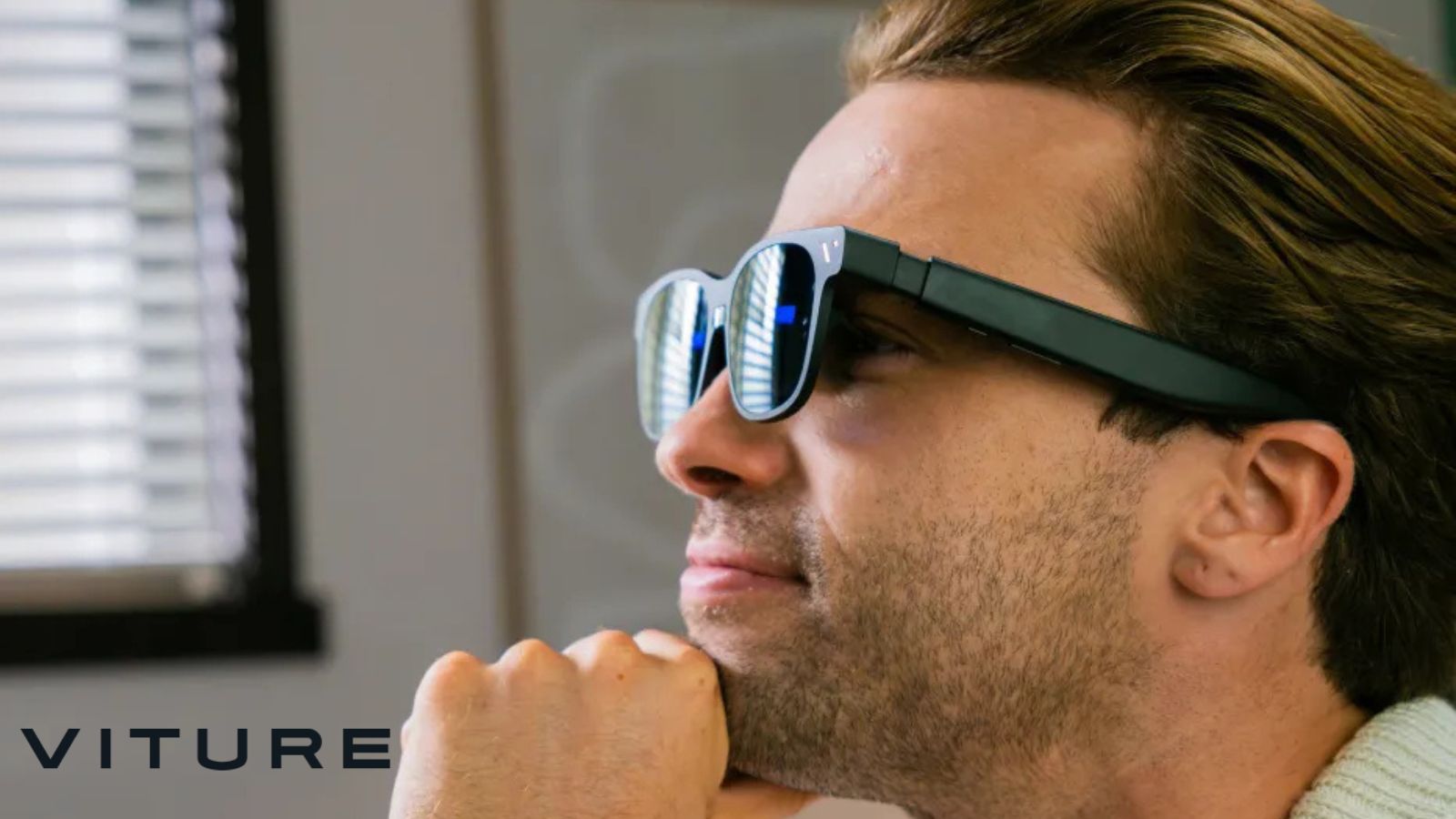

VITURE has launched the Pro 2, a new pair of wired AR glasses aimed at users who want a more portable private display for work, travel and entertainment.
Priced at $299, the Pro 2 represents a notable shift for VITURE. The company says the new model is both thinner and lighter than its predecessor while launching at a considerably lower price point.
At 63 grams, it is 20 percent lighter and 16 percent thinner than the original VITURE Pro.
“Five years ago, we answered the question, ‘Can XR glasses work?’, said Emily Wang, co-founder, VITURE.
“Today, VITURE Pro 2 answers a harder one: ‘Can they be a joy to wear, even for three hours straight?’
“Every upgrade in this collection was chosen with that question in mind. Some progress is written in specs. Five years in the making, this is a premium you can truly feel.”
For hybrid workers, the potential appeal is straightforward. Rather than carrying an additional portable monitor, users can connect the glasses to a compatible USB-C laptop, phone or handheld device and view a large virtual display in front of them.
The Pro 2 is not a standalone headset. It requires a wired USB-C connection to provide both content and power, so it is better understood as a personal display accessory than a fully independent mixed-reality device.
Display Comfort Is Central to the Update
VITURE is placing much of the emphasis on visual comfort, introducing what it calls UltraClarity 3.0. The company says the optical improvements address field curvature, image sharpness across the display, geometric distortion and image stability when a user’s eyes move away from the centre of the lenses.
Those claims will matter most in productivity scenarios. Watching a film can be forgiving of minor softness or distortion around the edges of a virtual display; reading documents, reviewing spreadsheets and working with dense interfaces is less so.
For glasses intended to function as an alternative to a second screen, clear text and a stable image are central to the experience.
The glasses use Sony micro-OLED displays with a resolution of 1,920 x 1,080 per eye and a 120Hz refresh rate.
The field of view has increased from 46 degrees on the earlier Pro model to 50 degrees, while perceived peak brightness has risen from 1,000 nits to 1,600 nits, according to VITURE.
A Potential Fit for Hybrid Work
The update may be relevant to employees accustomed to working across more than one display, but who cannot recreate that setup away from a permanent desk.
A lightweight pair of display glasses could provide extra screen space in a hotel room, airport lounge or shared workspace without adding a second physical monitor to a bag. It may also offer a degree of privacy when reviewing documents or working in public, although users would still need to account for their surroundings and any workplace data-handling policies.
VITURE has also included independently adjustable diopters for each eye, ranging from 0 to −5.00D. This may allow some short-sighted users to use the glasses without separate prescription lens inserts. People with more complex prescriptions, however, may still require a tailored optical solution.
Alongside the lower weight, VITURE has added upgraded temple padding, more nosepad adjustment options and an included lens shade. The latter is intended to reduce peripheral light and make the virtual display feel more immersive.
Not a Standalone Smart Glasses Device
The Pro 2 arrives as “smart glasses” becomes an increasingly broad category. Camera- and AI-led glasses are often designed around capturing photos, taking calls, hearing audio or accessing assistants. VITURE’s product is built around a different premise: delivering a large personal display from an existing device.
That distinction brings both advantages and constraints. A direct USB-C connection can make the Pro 2 a relatively simple way to use a laptop, smartphone or compatible handheld with a private virtual screen. But users must still manage a cable and carry a source device.
The glasses also use birdbath optics rather than waveguides. That design supports the display experience, but does not offer the slimmer profile associated with some other AR glasses. The Pro 2 does not include the camera sensors needed for 6DoF spatial tracking, meaning users cannot anchor a virtual screen at a fixed point in their physical environment.
A More Accessible AR Display Proposition
VITURE is positioning the Pro 2 for gaming and media consumption as well as computing, but its work-focused use case may be increasingly relevant. Hybrid work has made it harder for employees to access the multi-screen setup they may use at a conventional office desk.
Whether AR display glasses can replace a conventional monitor for long sessions will depend on individual comfort, device compatibility and text clarity in real-world productivity applications. However, at $299, the Pro 2 is priced alongside premium portable monitors while offering a setup that can fit into a bag rather than occupy desk space.