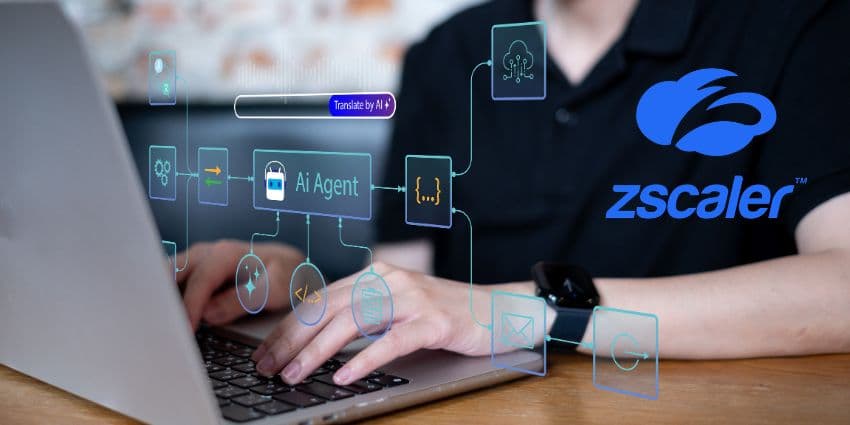
Zscaler has launched a suite of new products and platform updates designed to secure AI agents operating inside enterprise environments. The announcement extends the company's Zero Trust Exchange platform to cover how autonomous software agents connect to systems, access data, and run on employee devices.
The launch comes as businesses across industries accelerate deployment of AI agents, software that can act on behalf of users, chain tasks together, and interact with sensitive data without direct human instruction. Zscaler's platform operates across more than 160 data centers globally, serving large enterprises, critical infrastructure operators, and government agencies, and the latest update is designed to bring that reach to the fast-growing agentic layer of enterprise IT.
The core challenge the announcement addresses is not new technology. It is a security gap that has been quietly widening as AI deployment outpaced governance.
What Zscaler Has Built
At the center of the launch are two new offerings. AI Broker secures communications involving AI agents through MCP and A2A brokers, the protocols increasingly used to connect agents to tools, services, and each other. Endpoint AI Security is designed to detect and block AI-related threats directly on user devices, covering risks tied to browsers, plugins, extensions, and locally running AI tools.
Zscaler also introduced AI Access Graph, a mapping layer for data and identity connections across an organization. The technology originated from the company's acquisition of Symmetry Systems and is now integrated into the Zero Trust Exchange platform. It is designed to give security teams a clear view of how users, agents, applications, models, and data sources interact, enabling tighter access policies and reducing unnecessary exposure.
The launch also includes a broader expansion of AI Protect, a product line introduced earlier this year. New capabilities span three areas: AI asset management, access controls for approved AI tools, and protection for AI applications in both development and live environments. Asset management features now include discovery of embedded AI in SaaS and internet traffic, identification of AI agents and MCP servers in public cloud environments, and visibility into AI activity on endpoints.
On the access controls side, Zscaler has expanded prompt extraction across more than 250 generative AI applications, added full conversational views, and introduced support for Anthropic and OpenAI compliance APIs. For AI infrastructure, the platform now includes red teaming for MCP servers, a standalone prompt-hardening service, and compliance heat maps to help organizations govern AI applications more closely as they move from development into production.
Deployment Is Running Ahead of Governance
The timing of Zscaler's announcement reflects something the enterprise security industry has been slow to match. AI agents are already running inside organizations at scale, and in many cases the security infrastructure surrounding them was built for a different era.