
The push to bring employees back to the office has gathered significant momentum over the past two years. Business leaders across every sector have rolled out return-to-office mandates, with a consistent rationale: improving collaboration.
The assumption behind most RTO strategies is that distance is causing the collaboration problem. In reality, many frustrations driving the push back into offices have less to do with where people work and more to do with how poorly the technology supporting their meetings performs. According to IDC, 60% of remote participants find it difficult to interact, participate, or lead meetings as effectively as their in-office colleagues.
When people in a meeting room cannot hold a productive conversation with someone dialing in remotely, the issue is not hybrid work. The issue is the meeting itself. Mandating more days in the office to fix collaboration will not satisfy CEOs who want productivity, CHROs who want flexibility, or employees who want autonomy. There is, however, a way to satisfy all three, and it starts with AV.
Why So Many Hybrid Meetings Fall Short
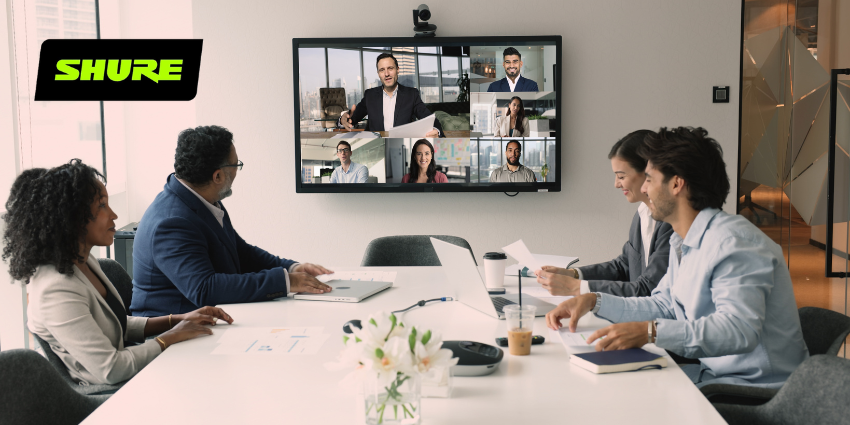
Walk into a shared meeting space today, and the experience is often unpredictable. Some rooms have basic USB cameras and speakerphones. Others rely on systems installed several years ago that have not kept pace with the platforms teams now use daily.
Whether it’s that speakers are not picked up accurately by the microphone or cameras fail to capture everyone around the table, the result is the same: remote participants struggling to follow what is happening in the room.
This problem is amplified by AI tools. If a room system cannot capture who was in the meeting, who was speaking, or what was said, checking recordings or transcripts becomes an effort in itself, erasing the efficiencies AI is meant to deliver.
Employees invest time preparing for meetings, attending them, and following up. But when technology introduces friction at every stage, the return on that time investment collapses.
As Josh Blalock, Collaboration Ecosystem and Engagement Director, at Shure, puts it:
“Employees should be focused on the business outcomes, but so much of their effort currently goes into facilitating that communication that it eats into the outcomes they should be focused on.”
Related Articles:
- AV in IT: Examining the New Security Challenges
- Secure by Design: Why Smarter AV Procurement is Key to Strengthening Cybersecurity
What Better AV Actually Looks Like
The good news is that the hardware gap is solvable, and solving it delivers returns that go well beyond cleaner audio. Shure calls this raising the Collaboration Quotient, a measure of how effectively people, processes and tools work together to drive performance. Most organisations are operating well below their potential on that metric. Luckily, the starting point for any AI-ready collaboration environment is the same: a microphone solution that captures every voice in the room clearly and consistently at scale, regardless of where participants are seated.
Shure ceiling-mounted microphone arrays like the MXA920 are designed for this. They provide even coverage across the room, meaning the executive at the back of the table is captured as clearly as the team lead at the front.
A ceiling mic array from Shure, paired with DSP-level audio processing, does not simply pick up sound; it filters out background noise, neutralizes acoustic issues, and delivers a clean, reliable, consistent audio signal before it reaches the platform. The result is an AI transcript that accurately reflects what was said, by whom, and in what order. That is the foundation for useful post-meeting summaries and action items.
For organizations ready for a full room upgrade, Shure’s IntelliMix Bar Pro extends this by addressing video alongside audio. Cameras at each end of the bar provide cross-table angles that ensure every participant is visible for remote attendees, with telephoto lenses delivering a clear, close-up image even for those seated at the far end of a large room.
For IT decision-makers who may not in in a position to do a complete technology refresh, Shure has built a solution for that reality. The Foundation System is a Windows-powered compute unit with a touch panel that allows organizations to integrate existing audio and video hardware into a fully Teams-certified room setup. For IT, that means lower total cost of ownership, stronger security, simpler manageability across multiple spaces, and a scalable path to upgrading the rest of the estate. As Blalock explains:
“It gives customers the choice and flexibility they need to get up to speed, up to date, and to make sure every space is truly AI-powered.”
Keeping Hybrid and Making It Work
Bringing people back to the office will not improve collaboration if the meeting rooms they return to still deliver a poor experience for remote participants. What changes outcomes is the quality of the environment they are walking into.
That requires investment in the spaces where work happens. A meeting room that captures every voice cleanly, identifies every speaker accurately, and feeds reliable data to the AI tools teams depend on is a meeting room worth traveling to. It is a meeting room worth travelling and dialling into.
The real barrier to hybrid collaboration was never location, so the office is not the answer. The meeting room AV is.
To bring your hybrid collaboration experience to in-person parity, visit Shure.