
Retail doesn’t wait. It doesn’t slow down for missed calls, dropped video links, or disconnected store teams. Whether you’re running 30 stores or 3,000, your frontline workers, HQ staff, logistics partners, and customer service agents all need to be on the same page, often quite literally.
In 2025, that means investing in a unified communications and collaboration platform that authentically connects your workforce, flexes around your tech stack, and helps you move fast without breaking things.
The problem is that most platforms weren’t built with retail in mind. They were made for offices, not aisles. That’s why IT and tech leaders in retail need to look beyond buzzwords and focus on what actually works for their business: mobility, integrations, speed, scale, and a platform that understands the organised chaos of retail operations.
Here’s what’s broken in retail communication today, and suggestions for how to fix it.
The Communication Headaches Retail Can’t Afford
Arguably, most retail communication setups are a mess. HQ uses Microsoft Teams, stores rely on group chats or personal mobiles, and customer service runs on a contact centre that barely talks to anything else. The result is often disconnected teams, duplicated work, missed opportunities, and managers scrambling to pull information from five different systems.
Add in high staff turnover, perpetually shifting rotas, supply chain glitches, and pressure to deliver standout customer experiences, and suddenly, reliable comms are absolutely essential.
Facilities and HR teams struggle to roll out consistent training and updates, IT is stretched trying to keep everything patched and connected, and execs want real-time data from every corner of the operation. It’s no wonder more retailers are ditching fragmented tools for UC platforms that bring voice, video, messaging, and collaboration into one place.
What Retailers Should Really Look for in a UC&C Platform
Forget the fluff. Retailers need platforms that are:
Mobile-first and store-ready. Your people aren’t sitting at desks; they’re on the floor, in the backroom, or on the move. The platform needs to work seamlessly across devices, even on flaky Wi-Fi.
AI-smart, not AI-hype. You don’t need AI that generates poems. You need AI that routes calls smartly, writes summaries, flags issues, and helps your teams move faster.
Plug-and-play with your stack. Whether it’s POS systems, ERP, inventory tools, or Salesforce, your UC platform has to speak the same language. Otherwise, you’re just building another silo.
Compliant and secure. Retail handles a lot of sensitive data, such as payment info, customer profiles, and staff records. If your platform doesn’t have baked-in compliance, it’s a liability.
Simple to scale. You don’t want a 12-month rollout across regions, but a system that works across 1 site or 1,000, with admin controls that don’t require a PhD.
Now, let’s get into the contenders.
Microsoft Teams: The Corporate Backbone (But With Retail Grit?)
If you’re already deep in the Microsoft ecosystem, Teams feels like a natural choice. It ties neatly into Outlook, SharePoint, OneDrive, Excel; the whole M365 gang. You get chat, calls, meetings, file-sharing, task management, and some solid security under the hood.
Teams excels at internal collaboration, particularly. It’s great for head office, finance, HR, and training. You can spin up Teams channels for different stores or departments, drop in files, run live video training, and keep everything archived and auditable.
The downside might be that it’s a bit corporate. If your store staff aren’t used to it, onboarding can feel heavy. Meanwhile, Microsoft has improved its webinars and external meeting features, but it’s still a step behind Zoom in terms of external-facing capabilities.
Good for: Retailers already using Microsoft 365, or with large HQ teams needing structured workflows.
Watch out for: Extra costs if you also need Zoom, and a steeper learning curve for non-desk workers.
Zoom Workplace: The People’s Favourite, Now With More Muscle
Zoom used to be the video call app. Now, it’s a full UC platform, Zoom Workplace, which combines meetings, chat, whiteboard, phone, and AI tools. It’s slick, lightweight, and ridiculously easy to use.
For retailers, Zoom hits the sweet spot when it comes to training, vendor collaboration, or cross-store meetings. The interface is clean, mobile-friendly, and familiar even to new hires. Zoom’s AI tools, like meeting summaries and smart recordings, cut admin time. If you need to bring in partners, franchisees, or external vendors, it’s hard to beat.
That said, integration with legacy systems or complex workflows isn’t as deep as Microsoft or RingCentral. Also, if you’re also using Teams for internal stuff, running both adds up.
Good for: Retailers who prioritise ease-of-use, training, and smooth external communications.
Watch out for: Integration gaps and potential platform overlap if you’re already tied to Microsoft.
RingCentral: Built for Call-Heavy, Always-On Retail Ops
RingCentral takes voice seriously. It’s built for organisations where the phone still rules: contact centres, support teams, and store-to-HQ comms. But it also includes messaging, video, task tools and a powerful mobile app.
Retailers with centralised support hubs or distributed customer service teams will appreciate its deep call routing, voicemail-to-text, analytics, and AI-powered assistant tools. It integrates well with Salesforce, Microsoft, Google, and other key enterprise apps. Additionally, it’s built for scale. If you’re opening new sites, it grows with you.
It has a bit more of an “old-school enterprise” feel, which can be a plus or minus depending on your culture. The interface isn’t as friendly as Zoom’s, but the backend is rock solid.
Good for: Retailers who run large contact centres or prioritise high-volume voice and customer interactions.
Watch out for: A slightly clunky interface and pricing complexity depending on features.
Cisco Webex: Enterprise Power, If You’ve Got the Muscle
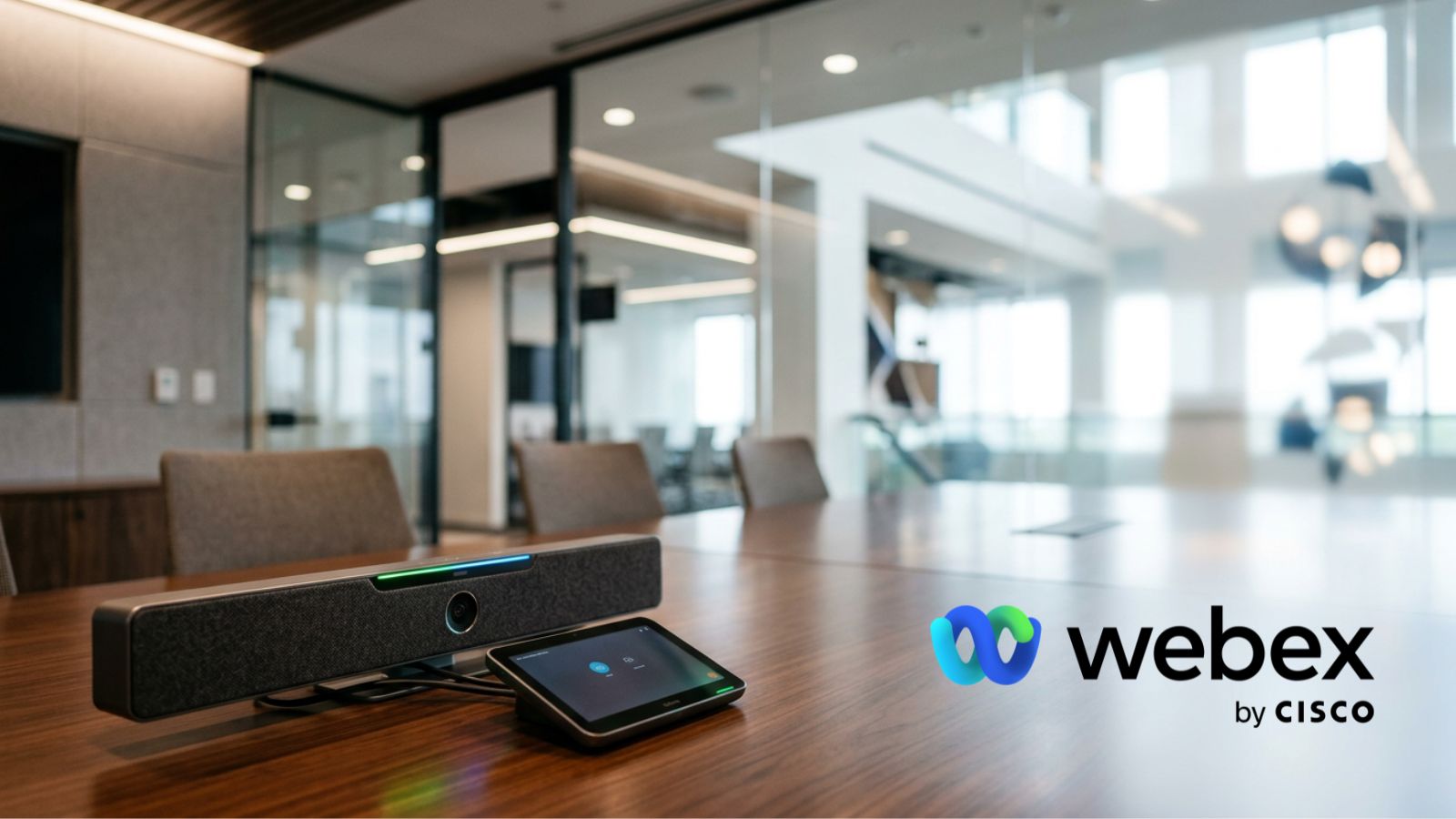
Cisco Webex has been doing this for decades, and it shows. Its infrastructure is secure, reliable, and compliant across global regions. It comes with advanced calling, messaging, meeting, and contact centre tools, plus excellent in-room hardware support if you’re building next-gen collaboration spaces at HQ or in flagship stores.
It’s a strong option for larger or global retailers that need strict compliance and performance guarantees. However, it does come with a learning curve, and it’s not always intuitive for store staff.
Good for: Global or security-conscious retailers needing bulletproof infrastructure.
Watch out for: Complexity and heavier deployment requirements.
Mitel: The Quiet Contender for Hybrid Environments
Mitel often flies under the radar, but it’s got some serious strengths, especially for retailers with legacy phone systems or hybrid environments. It supports on-prem, cloud, or hybrid setups, integrates with Teams, and doesn’t force you to rip and replace.
It’s less flashy than Zoom or Teams, but it does the job well, particularly for voice-centric operations that want a phased move to the cloud. The interface feels a bit dated in places and lacks some of the newer AI tools, but for certain retailers, that’s a fair trade-off for flexibility.
Good for: Retailers with existing Mitel infrastructure or hybrid comms environments.
Watch out for: Less modern UI and fewer native integrations.
The Bottom Line
Retailers categorically need a platform that can handle the realities of the shop floor, the boardroom, and the call centre without missing a beat. In 2025, the best UC&C solution is the one that brings your people, your tech stack, and your customers together in real time.
Go with Microsoft Teams if you’re all-in on M365 and need a structured, secure environment.
Choose Zoom if you want ease, adoption speed, and standout external meeting experiences.
Pick RingCentral if voice is your lifeline and contact centres are core to your business.
Lean toward Webex if you want a fortress of compliance and enterprise reliability.
Look at Mitel if you’re transitioning from legacy systems and want a flexible migration path.
Just don’t settle for a platform that doesn’t get retail. Because in this industry, the difference between “out of stock” and “sold out” often comes down to how fast your teams can communicate.