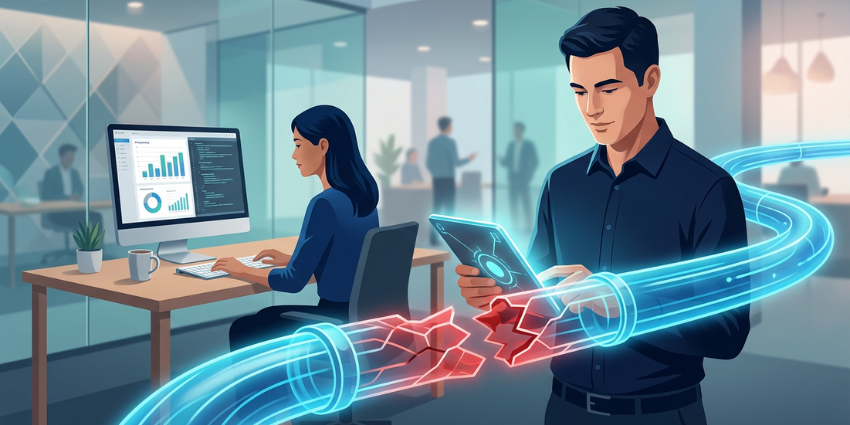

When evaluating observability vs monitoring, the distinction is simple: standard service monitoring tools tell you a system is broken, while real-time observability tells you exactly why.
Most organizations rely on traditional monitoring to track known metrics and predefined conditions. This approach creates a massive blind spot, forcing IT teams to wait for thresholds to break before taking action. To achieve true system visibility enterprise leaders must adopt a modern IT observability strategy.
Understanding the core difference in observability vs monitoring is critical for modern service management. True observability reveals unknown system behavior before it impacts the end user. It reframes failure as an observability gap, allowing teams to detect anomalies instantly.
Related Articles
- What Is Negative Maintenance? The Principle Transforming IT
- Why Is Your UC Reliability Only as Strong as the Weakest Network You Don’t Own?
- How AI is Reshaping IT Operations and Service Management
What is the difference between monitoring and observability?
Monitoring checks your systems against predefined rules. It answers a simple question. Is the system working right now?
Observability goes much deeper. It helps you understand internal system states by looking at external outputs. It answers a much harder question. Why is the system acting this way?
A strong IT observability strategy assumes that systems will fail in unpredictable ways. Monitoring only tracks the problems you expect. Observability gives you the power to investigate problems you have never seen before.
Why does monitoring fail to detect unknown issues?
Dashboards only display the specific data you ask them to show. They rely entirely on static thresholds and past experiences.
If a completely new type of failure occurs, standard service monitoring tools often stay green. You cannot write an alert for a problem you cannot predict.
During a recent UC Today roundtable on service management, Chethan Visweswar, Chief Product Officer at Movius, highlighted this growing gap:
“Observability and monitoring is still not where it needs to be… there is an impedance mismatch between how fast companies are adopting these technologies and how well they’re able to manage them.”
Monitoring treats complex software like a simple machine. It fails because modern cloud environments change constantly and behave unpredictably.
How do organizations miss emerging system failures?
Teams miss failures because they look at isolated metrics. A slight CPU spike might look perfectly normal on a standard dashboard.
However, that same spike combined with a slow database query indicates an impending crash. Without real-time observability, these subtle anomalies easily slip through the cracks. The system degrades silently in the background.
In the same UC Today roundtable, Irwin Lazar, President and Principal Analyst at Metrigy, pointed out the danger of this approach:
“Companies typically waited six months to a year to address service management. They assumed it would work – and then went back to the drawing board when it didn’t because of customer complaints and user complaints.”
Eventually, the application breaks entirely. The end users become the actual alerting system. Relying on customer complaints to find IT outages destroys business trust quickly.
Join the conversation and follow UC Today on LinkedIn for the latest enterprise technology insights.
Where does visibility break down in service management?
Visibility breaks down when departments operate in isolated silos. The network team looks exclusively at network data. The application team only watches application metrics.
Nobody sees the complete picture. True system visibility enterprise leaders require a unified perspective across all environments. Failures almost always happen in the hidden gaps between these siloed tools.
When an incident occurs, teams waste hours arguing over whose dashboard is correct. This fragmented approach makes root cause analysis nearly impossible.
How should enterprises build observability systems?
Building this capability requires collecting high-quality telemetry data. Teams must gather metrics, logs, and traces into one unified platform.
You must connect these data points to understand the full context of any event. Enterprises should shift their culture away from reactive dashboard watching. They need to encourage proactive investigation and hypothesis testing.
Implement platforms that support deep, ad-hoc queries into system behavior. This empowers engineers to ask new questions about their systems at any time.
Final Takeaway
Relying solely on traditional service monitoring tools leaves your organization vulnerable to unknown failures. You cannot fix what you cannot see or understand.
Adopting a real-time IT observability strategy allows DevOps teams to explore system behavior dynamically. It transforms service management from a reactive scramble into a proactive science.
Ready to stop fighting IT fires and start preventing them entirely? Dive into our Service Management & Connectivity Guide to uncover the secrets.
FAQs
What is the main difference between observability vs monitoring?
Monitoring tells you when a known problem occurs. Observability helps you understand why an unknown problem is happening.
Why do traditional service monitoring tools fail?
They fail because they only track predefined conditions. They cannot alert you to novel issues or unexpected system behavior.
How does real-time observability help DevOps teams?
It allows teams to detect anomalies instantly. Engineers can investigate root causes before the issue impacts the end user.
What defines system visibility enterprise standards?
It means having a unified view across all applications and networks. It eliminates data silos between different IT departments.
How do you start an IT observability strategy?
Start by collecting metrics, logs, and traces in one place. Then give your teams tools to query that data dynamically.