
The smart meeting room has spent a decade being sold on connection. Get a camera and a microphone into every space, the argument went, and the remote worker is in the meeting. The pitch has now run out of road. The conversation has moved from connecting people to understanding what happens once they are connected. The newer goal is to embed AI directly into the hardware that captures the room.
The distinction that matters is between AI that improves the room and AI that simply gives a product a more current label. Jenn Heinold, Senior Vice President of Expositions for the Americas at AVIXA, told UC Today where the line sits.
The best AI is an enhancement to AV, and not the other way around. The best AI is what’s making AV more proficient, efficient, and personalised.
That test runs through every part of the AI meeting room story: video, audio, the assistant that writes up the meeting afterwards, and the harder questions of equity and trust that the technology cannot answer on its own.
AI-Powered Video: Cameras That Understand the Room
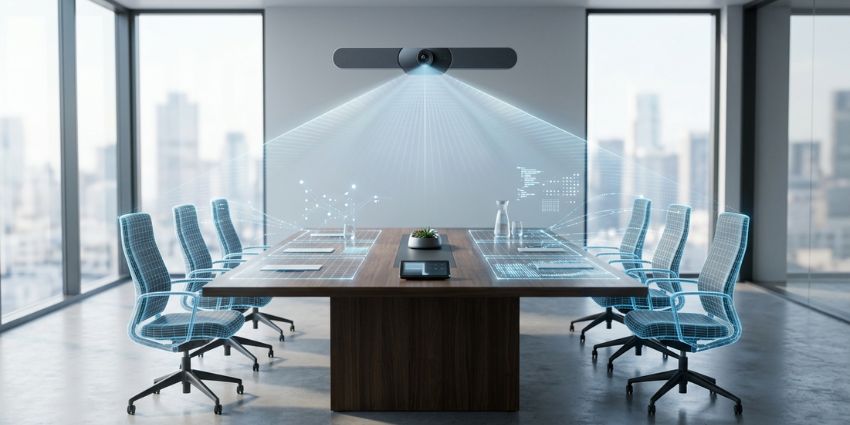
The clearest change is in what cameras are now expected to do. Speaker tracking, group framing, and multi-stream layouts have moved from premium features to baseline expectations, and the vendor argument has shifted from image quality to scene understanding. The point of all of it is the person who is not in the room: framing exists to make the remote participant feel as present as the people around the table.
The mechanics have become noticeably more sophisticated. Logitech’s Rally AI Camera and Rally AI Camera Pro, shipping through 2026, use RightSight 2 framing and support Group View, Speaker View, and Grid View. In multi-camera setups, the system blends inputs from several cameras rather than switching abruptly between them. A Camera Zone feature restricts framing to a defined area, so activity outside the meeting does not pull the shot away. The Pro model adds Presenter View, which keeps a moving speaker framed within set boundaries. That is the kind of feature aimed at training rooms and lecture halls where a presenter does not stay still.
The harder problem these systems are starting to solve is conversational, not mechanical. A camera that snaps to each speaker in turn produces a disorienting ping-pong effect during a fast exchange. Newer systems read the pattern of a conversation. They recognise when two people are going back and forth, then pull wide to hold both in frame rather than cutting between them. For remote participants, that is the difference between watching a meeting and following one. For large rooms, classrooms, and town halls, this contextual framing is where the visible AI investment is going.
AI-Powered Audio: The Foundation Everything Else Sits On
Audio is the layer the rest of the AI meeting room depends on, and the one most often underspecified. Every feature above it, transcription, summarisation, action items, speaker attribution, is only as good as the signal the room captures. Poor audio does not just make a meeting harder to hear. It degrades every AI output built on top of it.
UC Today set this out in its analysis of why better meeting experiences come before better AI. Transcripts, recaps, action items, and speaker attribution are only as accurate as the audio and video signals feeding them. When microphones miss voices or a room cannot reliably capture who is speaking, AI does not reduce effort. It introduces rework and uncertainty, because the summary now has to be checked rather than trusted.
This is why beamforming microphone arrays, voice isolation, and AI noise suppression have become standard rather than premium. Ceiling array microphones with onboard digital signal processing capture talkers evenly across a room. They hand a clean input to the agents working downstream, whether that is Facilitator in Copilot for Microsoft Teams or any other platform assistant. The competitive question has moved underneath the noise suppression most buyers notice. It is now about whether the room can hand the platform a signal clean enough for speaker identification to be reliable. That is the dependency everything else rests on.
AI Meeting Assistants: From Note-Taker to Workflow
The third layer is what happens after the meeting. For the past three years, AI in unified communications generally meant one thing: a summary at the end of the call. UC Today set out how AI is moving from note-taker to co-worker. The major platforms are now making the case that the assistant should participate in the meeting, not just recap it: surfacing documents mid-conversation, assigning action items in real time, and coordinating room systems based on what is happening around the table.
The mechanics are arriving fast. Zoom’s AI Companion identifies separate speakers and logs action items automatically, while Microsoft’s Intelligent Recap adds timeline markers and chapters in Teams. Google has extended its Gemini-powered notetaker into in-person meetings. It positions the feature as a capture layer for conversations wherever they happen, rather than a feature of any one platform. The throughline is that the meeting room is no longer just a place where conversations happen. It is where they are captured, indexed, and fed into the tools where work actually gets done.
That shift puts a heavier load on the room itself. Nathan Glotfelty, Senior Director of Alliances at Q-SYS, framed the consequence as a question every workplace now has to answer, whether or not it is ready.
We don’t get to opt out of the question of: is your workspace ready for an agentic future? Facilitator is real, Copilot is real. They are going to be asking questions of our workplaces and the only question left for us is: does the workplace have anything to say back?
An assistant that assigns action items and coordinates room systems needs to know who is in the room, who is speaking, and whether the space is working. The post-meeting promise, a record usable by anyone who needs it afterwards, depends on the room supplying accurate context in the first place.
Meeting Equity: What the Technology Can and Can’t Fix
The case for the AI meeting room is, at its core, an equity case. Better cameras, cleaner audio, and reliable transcripts are meant to give the remote participant the same standing as the person in the room. The research suggests the gap is real and persistent. IDC found that 60% of remote meeting participants struggle to interact, participate, or lead as effectively as their in-office colleagues. Barco’s meeting barometer puts the figure higher still. Its research found 71% of employees struggling with hybrid meetings, and one in three remote workers feeling less engaged than on-site colleagues.
The technology is moving in the right direction. Intelligent cameras with individual speaker tracking mean remote participants see the person speaking at consistent framing rather than a wide shot of a distant table. Beamforming microphones isolate voices, and AI noise suppression removes distractions. The harder truth is that none of it solves equity on its own. Research published this year points to a consistent pattern. Remote participants in asymmetric hybrid meetings receive less speaking time, are less likely to have their ideas attributed correctly in meeting notes, and disengage faster than in-room participants. That holds regardless of room specification.
Jitesh Gera, Research Manager within IDC’s UC&C continuous information service, told UC Today that the underlying shift is genuine.
Over the past few years, hybrid working norms and a rapidly rising interest in AI-powered business communications have started to push organisations to redesign their workplaces and video-enable their office spaces for effective collaboration outcomes.
The distinction that matters for buyers is between the technical and the behavioural. Cameras and microphones address visibility, audibility, and accurate attribution in the record. They can’t make the in-room group turn to face the screen when a remote colleague speaks, or draw quieter voices into the conversation. The technology lowers the barrier to participation. It does not clear it. Organisations that redesign meeting formats alongside the hardware consistently see larger engagement gains than those that buy new cameras and change nothing else.
Trust and Accuracy: Where the AI Meeting Room Gets Risky
The weakest point in the AI meeting room is the same as its selling point: the record. Summaries, transcripts, and action items are only useful if they are right, and the evidence in 2026 is that accuracy is conditional, not guaranteed.
On clean, single-speaker audio, the best transcription engines reach 95 to 98 percent accuracy. In real meetings, with crosstalk, background noise, and distant microphones, that figure can fall below 80 percent. The errors cluster in predictable places. Non-native speakers see accuracy gaps of 15 to 30 percent against native speakers, because the models were trained disproportionately on the latter. Industry jargon, proper nouns, and surnames are among the most error-prone elements. That is precisely the content that matters most in a business meeting.
Why Speaker Attribution Is the Real Risk
Speaker attribution is the specific risk for meeting rooms. Guidance circulating in 2026 advises reviewers never to trust AI speaker labels in any meeting with three or more participants without manual confirmation. A summary that confidently assigns a decision or a commitment to the wrong person does not just contain an error. It creates a record that can be acted on. Hallucination compounds the problem. Leading models are known to invent or repeat content during silences, producing fluent text that reads as authoritative and is wrong.
The governance questions arrive alongside the accuracy ones. UC Today noted as much when Google extended its notetaker into physical rooms. Consent requirements for recording vary across US states, around a dozen require all-party consent, and GDPR adds further complexity for European operations. Systems that attribute speech to named individuals may also trigger biometric data obligations under frameworks such as Illinois’ BIPA. These are the first questions a legal or compliance team will raise. They are best answered before deployment rather than after.
This is where the equity argument and the accuracy argument meet. A remote participant on a poor connection, or one with an accent the model handles less well, faces a double hit. They are less likely to be heard correctly in the moment, and less likely to be transcribed and attributed correctly in the record. The same conditions that undermine equity also undermine accuracy, and they fall on the same people. It is also why the industry emphasis on clean capture matters beyond audio quality. Fixing the signal at the source is the only reliable way to fix the record built on top of it.
What Buyers Should Take Away
The direction of the AI meeting room is settled. Cameras that understand the scene, audio engineered to feed AI rather than just carry voice, and assistants that turn meetings into searchable records are now the baseline of a premium room. The open questions are about deployment, not direction.
For organisations reviewing room investments, the useful question is not whether a vendor’s AI features are real. They are. It is whether those features deliver measurable improvement in their specific rooms, with their specific people. It is also whether the record the system produces is accurate enough to be trusted when it matters. The AI meeting room can improve equity, productivity, and follow-through. Whether it does depends on conditions the technology does not control on its own: the quality of the audio feeding it, the honesty of the accuracy claims around it, and whether the organisation is willing to change how it runs meetings rather than just what sits on the wall.