
A field engineer three hours from the nearest town, a delivery driver on a rural route, a sensor on a shipping container somewhere in open water: none of them have a cell signal, and none of them are helped by the satellite dish sitting on an office roof. That’s the gap Amazon is now trying to close with hardware nobody has to install.
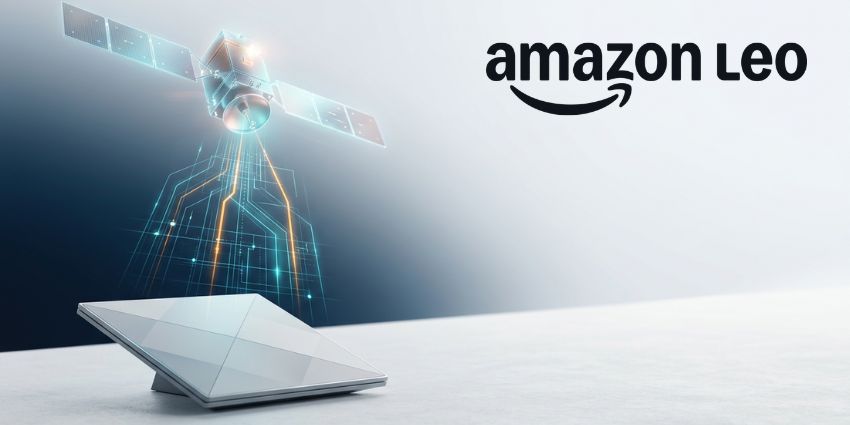
Amazon filed an application with the Federal Communications Commission late on 24 July for the Amazon Leo Direct-to-Device (D2D) System, a proposed constellation of up to 5,105 low Earth orbit satellites built to deliver voice, messaging, data and emergency connectivity straight to standard mobile phones. No dish, no terminal, no cell tower in range required.
What Amazon Actually Filed
The D2D system would sit alongside Amazon Leo’s existing broadband constellation, currently at more than 390 satellites in orbit, rather than replace it. According to the filing, reported by SpaceNews, the network would operate across five orbital shells at altitudes between 510 and 580 kilometres, using L-band and S-band spectrum to talk to devices directly and Ka-band and V-band links to connect satellites to ground stations.
The satellites process communications in orbit rather than acting as a simple relay between ground stations, routing traffic between each other over optical laser links to cut latency and improve overall network efficiency. Amazon’s filing describes the goal as
“enabling service directly to users’ mobile devices”
in places where terrestrial coverage doesn’t reach, working alongside Amazon’s existing satellite systems and the Globalstar-owned HIBLEO and C-3 constellations it will inherit.
None of it is legal without spectrum, which comes from Globalstar. Amazon’s planned $11.6 billion acquisition of the satellite operator, announced in April, gives it access to mobile satellite spectrum licences authorised in more than 120 countries. That deal is expected to close in 2027, with D2D satellite launches following in 2028. Until it closes, Amazon has no legal right to transmit to phones at all.
A Frontline Workforce Story, Not a Broadband One
Amazon’s filing names the use cases directly: fleet management, remote worksite connectivity, emergency response coordination, and IoT sensor networks operating outside terrestrial coverage. Not office connectivity. Workers and equipment that move through coverage gaps a fixed satellite dish can’t reach.
Amazon Leo also holds an existing agreement with Apple to power satellite features on iPhone and Apple Watch, including Emergency SOS, Messages, Find My and Roadside Assistance, giving it a working relationship with device-level satellite integration before the D2D constellation has launched a single dedicated satellite.
Deskless and frontline workers, the engineers, drivers, warehouse staff and field technicians who make up roughly 80% of the global workforce, are the group most exposed to coverage gaps and least served by tools built around a desk and Wi-Fi. A phone that falls back to satellite the moment it loses signal is a different proposition for that workforce than another dish at head office.
Amazon’s broader Leo business already has commercial momentum, even where the D2D system doesn’t yet. In April, Amazon signed Delta Air Lines to fit Amazon Leo broadband terminals across 500 aircraft from 2028, a separate product from the D2D filing but part of the same push into markets Starlink has dominated by default. Announcing the deal, Andy Jassy, President and CEO of Amazon, said:
“Leo’s speed and reliability is going to have a big impact for businesses, governments, and consumers”
Businesses come first in that list, ahead of consumers, which tracks with how the D2D filing itself reads: fleet, worksite and IoT use cases named specifically, ahead of any consumer pitch.
Starlink and AST SpaceMobile Already Have Live Service
Amazon isn’t filing into open ground. SpaceX already offers direct-to-cell service commercially through Starlink Mobile, in partnership with T-Mobile in the US, using spectrum acquired from EchoStar: the same phone-to-satellite category Amazon is now proposing, not Starlink’s separate broadband dish business. AST SpaceMobile has separately demonstrated two-way voice calls from space to unmodified smartphones and has its own carrier partnerships in place. Both have a multi-year head start on Amazon in live direct-to-phone service, not just filings.
Starlink’s wider commercial momentum makes the gap harder to ignore. Announcing its Emirates inflight broadband partnership earlier this year, Chad Gibbs, VP of Starlink Business Operations, said passengers would be able to
“stream, game, and have seamless video calls”
on Starlink-equipped flights, much as they would on the ground. That’s a different Starlink product to Starlink Mobile, but it’s a company already running live commercial satellite services across multiple markets. Amazon Leo’s D2D system has no paying customers, no live network, and a filing that hasn’t been approved yet.
Amazon’s own broadband service, under its current FCC licence, only recently began fixed enterprise broadband. The D2D system won’t launch before 2028, and that date depends on a Globalstar deal that hasn’t closed yet. This is a multi-year regulatory and infrastructure story, not a service anyone can evaluate today.
What It Means for Workforce Connectivity Planning
Satellite fallback for ordinary phones currently exists only through Starlink Mobile and AST SpaceMobile, both tied to specific carrier partnerships and still expanding coverage. A third credible entrant, backed by Amazon’s existing device relationships through Apple and its own carrier ambitions, gives organisations with large deskless workforces an actual choice of provider instead of a single, carrier-locked one. UC Today has flagged the same problem in unified communications continuity planning: a single point of failure dressed up as a backup plan isn’t resilience, whether that’s a UC platform or a satellite carrier agreement.
It could also change the economics of mobile-first UC deployments. UC Today has previously covered how organisations are building UC-integrated mobile telephony for frontline and deskless staff as an alternative to legacy fixed lines. Reliable satellite fallback on ordinary phones removes one more reason those workers need separate, purpose-built hardware to stay reachable in coverage gaps.
The Reality Check
Amazon needs the Globalstar acquisition to close, expected in 2027. It needs the FCC to approve a filing that competitors, including SpaceX, have previously contested on spectrum grounds. And it needs to build and launch a constellation nearly double the size of its current Leo broadband fleet, which itself only reached enterprise beta status this year. This is genuinely years out.
Starlink Mobile and AST SpaceMobile are live now and Amazon’s isn’t, so the near-term choice for frontline connectivity is between those two. But carrier and device commitments made today should leave room for a third satellite-to-phone option within two to three years, rather than assuming Amazon never gets there.