
Hybrid work turned communications into the business. Not a tool. When meetings get weird, calls clip, or joining takes three tries, teams can’t “wait it out.” They have to route around it. Personal mobiles. WhatsApp. “Just call me.” The work continues, but your governance, your customer experience, and your credibility take a hit.
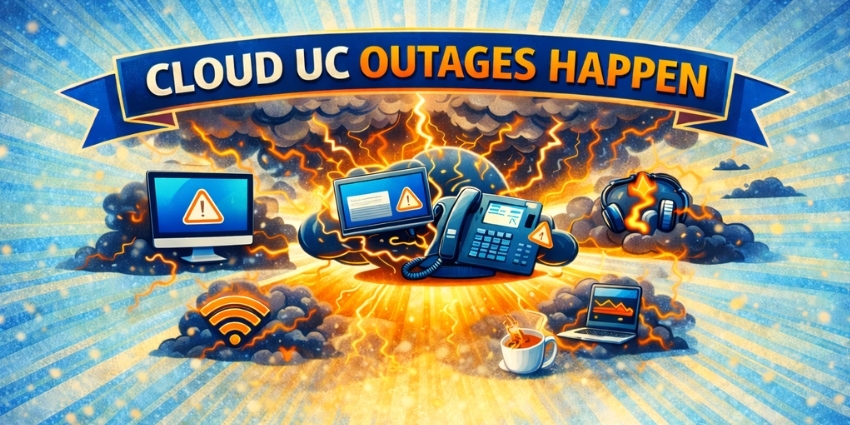
It’s strange how, in this environment, a lot of leaders still treat outages and cloud issues like freak weather. They’re not. Around 97% of enterprises dealt with major UCaaS incidents or outages in 2023, usually lasting “a few hours.” Big companies routinely pegged the damage at $100k–$1M+.
Cloud systems might have gotten “stronger” in the last few years, but they’re not perfect. Outages on Zoom, Microsoft Teams, and even the AWS cloud keep happening.
So really, cloud UC resilience today needs to start with one simple assumption: cloud UC will degrade. Your job is to make sure the business still works when it does.
Related Articles:
- XLAs for Unified Communications: Why XLAs are Replacing SLAs in UC
- The 90 Day Playbook for ITSM & Connectivity Adoption Success
- IT Service Management & Workplace Connectivity Trends to Watch in 2026
Cloud UC Resilience: The Failure Taxonomy Leaders Need
People keep asking the wrong question in an incident: “Is it down?”
That question is almost useless. The better question is: what kind of failure is this, and what do we protect first? That’s the difference between UCaaS outage planning and flailing.
Platform outages (control-plane / identity / routing failures)
What it feels like: logins fail, meetings won’t start, calling admin tools time out, routing gets weird fast.
Why it happens: shared dependencies collapse together—DNS, identity, storage, control planes.
Plenty of examples to give here. Most of us still remember the failure tied to AWS dependencies rippled outward and turned into a long tail of disruption. The punchline wasn’t “AWS went down.” It was: your apps depend on things you don’t inventory until they break.
The Azure and Microsoft outage in 2025 is another good reminder of how fragile the edges can be. Reporting at the time pointed to an Azure Front Door routing issue, but the business impact showed up far beyond that label. Major Microsoft services wobbled at once, and for anyone depending on that ecosystem, the experience was simple and brutal: people couldn’t talk.
Notably, platform outages also degrade your recovery tools (portals, APIs, dashboards). If your continuity plan starts with “log in and…,” you don’t have a plan.
Regional degradation (geo- or corridor-specific performance failures)
What it feels like: “Calls are fine here, garbage there.” London sounds clean. Frankfurt sounds like a bad AM radio station. PSTN behaves in one country and faceplants in another.
For multinationals, this is where cloud UC resilience turns into a customer story. Reachability and voice identity vary by region, regulation, and carrier realities, so “degradation” often shows up as uneven customer access, not a neat on/off outage.
Quality brownouts (the trust-killers)
What it feels like: “It’s up, but it’s unusable.” Joins fail. Audio clips. Video freezes. People start double-booking meetings “just in case.”
Brownouts wreck trust because they never settle into anything predictable. One minute things limp along, the next minute they don’t, and nobody can explain why. That uncertainty is what makes people bail. The last few years have been full of these moments. In late 2025, a Cloudflare configuration change quietly knocked traffic off course and broke pieces of UC across the internet.
Earlier, in April 2025, Zoom ran into DNS trouble that compounded quickly. Downdetector peaked at roughly 67,280 reports. No one stuck in those meetings was thinking about root causes. They were thinking about missed calls, stalled conversations, and how fast confidence evaporates when tools half-work.
Why Does Cloud Service Degradation Occur?
All of the problems above generally come from simple things. A small change in a very complicated system. Human error is the biggest starting point.
Routine maintenance, a configuration tweak, or an automation job pushing the wrong setting can spread quickly in cloud environments. At this scale, mistakes don’t stay small. A DNS change, routing update, or firewall rule can quietly interfere with traffic long before anyone realizes what happened. Software complexity can add problems, too.
Cloud platforms are constantly updating orchestration layers that manage compute, identity, networking, and storage. When one of those updates introduces a defect, the symptoms rarely show up where the change happened. APIs slow down. Authentication stalls. Services start behaving strangely without an obvious explanation.
There’s also all the physical infrastructure to think about. The cloud is a physical thing with servers that fail, storage systems that wear out, and network switches that don’t always do what they’re told. Even cables connecting data centers can break eventually.
Beyond that, outages can be caused by anything from DDoS attacks designed to overwhelm services with traffic to naturally increasing demand around peak periods.
UC Cloud Resilience: Why Degradation Hurts More Than Downtime
Downtime is obvious. Everyone agrees something is broken. Degradation is sneaky.
Half the company thinks it’s “fine,” the other half is melting down, and customers are the ones who notice first.
Here’s what the data says. Reports have found that during major UCaaS incidents, many organizations estimate $10,000+ in losses per event, and large enterprises routinely land in the $100,000 to $1M+ range. That’s just the measurable stuff. The invisible cost is trust inside and outside the business.
Unpredictability drives abandonment. Users will tolerate an outage notice. They won’t tolerate clicking “Join” three times while a customer waits. So they route around the problem, using shadow IT tech. That problem gets even worse when you realize that security issues tend to spike during outages. Degraded comms can create fraud windows.
They open the door for phishing, social engineering, and call redirection, because teams are distracted and controls loosen. Outages don’t just stop work; they scramble defenses.
Compliance gets hit the same way. Theta Lake’s research shows 50% of enterprises run 4–6 collaboration tools, nearly one-third run 7–9, and only 15% keep it under four. When degradation hits, people bounce across platforms. Records fragment. Decisions scatter. Your communications continuation strategy either holds the line or it doesn’t.
This is why UCaaS outage planning can’t stop at redundancy. The real damage isn’t the outage. It’s what people do when the system sort of works.
Graceful Degradation: What is UC Cloud Resilience?
It’s easy to panic, start running two of everything, and hope for the best. Graceful degradation is the less drastic alternative. Basically, it means the system sheds non-essential capabilities while protecting the outcomes the business can’t afford to lose.
If you’re serious about cloud UC resilience, you decide before the inevitable incident what needs to survive.
- Reachability and identity come first: People have to contact the right person or team. Customers have to reach you. For multinational firms, this gets fragile fast: local presence, number normalization, and routing consistency often fail unevenly across countries. When that breaks, customers don’t say “regional degradation.” They say “they didn’t answer.”
- Voice continuity is the backbone: When everything else degrades, voice is the last reliable thread. Survivability, SBC-based failover, and alternative access paths exist because voice is still the lowest-friction way to keep work moving when platforms wobble.
- Meetings should fail down to audio, on purpose: When quality drops, the system should bias toward join success and intelligibility, not try to heroically preserve video fidelity until everything collapses.
- Decision continuity matters more than the meeting itself. Outages push people off-channel. If your communications continuation strategy doesn’t protect the record (what was decided, who agreed, what happens next), you’ve lost more than a call.
Here’s the proof that “designing down” isn’t academic. RingCentral’s January 22, 2025, incident stemmed from a planned optimization that triggered a call loop. A small change, a complex system, cascading effects. The lesson wasn’t “RingCentral failed.” It was that degradation often comes from change plus complexity, not negligence.
Don’t duplicate everything; diversify the critical paths. That’s how UCaaS outage planning starts protecting real work.
How Can Organizations Prepare For UC Outages?
Everyone has a disaster recovery document or a diagram. Most don’t have a habit. UCaaS outage planning isn’t a project you finish.
It’s an operating rhythm you rehearse. The mindset shift is from: “we’ll fix it fast” to “we’ll degrade predictably.” From a one-time plan written for auditors to muscle memory built for bad Tuesdays.
The Uptime Institute backs this idea. It found that the share of major outages caused by procedure failure and human error rose by 10 percentage points year over year. Risks don’t stem exclusively from hardware and vendors. They come from people skipping steps, unclear ownership, and decisions made under pressure.
The best teams treat degradation scenarios like fire drills. Partial failures. Admin portals loading slowly. Conflicting signals from vendors. After the AWS incident, organizations that had rehearsed escalation paths and decision authority moved calmly; others lost time debating whether the problem was “big enough” to act.
A few habits consistently separate calm recoveries from chaos:
- Decision authority is set in advance. Someone can trigger designed-down behavior without convening a committee.
- Evidence is captured during the event, not reconstructed later, cutting “blame time” across UC vendors, ISPs, and carriers.
- Communication favors clarity over optimism. Saying “audio-only for the next 30 minutes” beats pretending everything’s fine.
This is why resilience engineers like James Kretchmar keep repeating the same formula: architecture plus governance plus preparation. Miss one, and Cloud UC resilience collapses under stress.
At scale, some organizations even outsource parts of this discipline, regular audits, drills, and dependency reviews, because continuity is cheaper than improvisation.
Service Management in Practice: Where Continuity Breaks
Most communication continuity plans fail at the handoff. Someone changes the routing. Someone else rolls it back. A third team didn’t know either had happened. Now you’re debugging the fix instead of the failure. This is why cloud UC resilience depends on service management.
During brownouts, you need controlled change. Standardized behaviors. The ability to undo things safely. Also, a paper trail that makes sense after the adrenaline wears off. When degradation hits, speed without coordination is how you make things worse.
The data says multi-vendor complexity is already the norm, not the exception. So, your communications continuation strategy has to assume platform switching will happen. Governance and evidence have to survive that switch.
This is where centralized UC service management starts earning its keep. When policies, routing logic, and recent changes all live in one place, teams make intentional moves instead of accidental ones. Without orchestration, outage windows get burned reconciling who changed what and when, while the actual problem sits there waiting to be fixed.
UCSM tools help in another way. You can’t decide how to degrade if you can’t see performance across platforms in one view. Fragmented telemetry leads to fragmented decisions.
How Does Observability Help with UC Cloud Resilience?
Every UC incident hits the same wall. Someone asks whether it’s a Teams problem, a network problem, or a carrier problem. Dashboards get opened. Status pages get pasted into chat. Ten minutes pass. Nothing changes. Outages become even more expensive.
UC observability is painful because communications don’t belong to a single system. One bad call can pass through a headset, shaky Wi-Fi, the LAN, an ISP hop, a DNS resolver, a cloud edge service, the UC platform itself, and a carrier interconnect. Every layer has a reasonable excuse. That’s how incidents turn into endless back-and-forth instead of forward motion.
The Zoom disruption on April 16, 2025, makes the point. ThousandEyes traced the issue to DNS-layer failures affecting zoom.us and even Zoom’s own status page. From the outside, it looked like “Zoom is down”. Users didn’t care about DNS. They cared that meetings wouldn’t start.
This is why observability matters for Cloud UC resilience. Not to generate more charts, but to collapse blame time. The leadership metric that matters here isn’t packet loss or MOS in isolation; it’s time-to-agreement. How quickly can teams align on what’s broken and trigger the right continuation behavior?
Interested to see top vendors defining the next generation of UC connectivity tools? Check out our helpful market map here.
Multi-Cloud and Independence Without Overengineering
There’s obviously an argument for multi-cloud support in all of this, but it needs to be managed properly.
Plenty of organizations learned this the hard way over the last two years. Multi-AZ architectures still failed because they shared the same control planes, identity services, DNS authority, and provider consoles. When those layers degraded, “redundancy” didn’t help, because everything depended on the same nervous system.
ThousandEyes’ analysis of the Azure Front Door incident in late 2025 is a clear illustration. A configuration change at the edge routing layer disrupted traffic for multiple downstream services at once. That’s the impact of shared dependence.
The smarter move is selective independence. Alternate PSTN paths. Secondary meeting bridges for audio-only continuity. Control-plane awareness so escalation doesn’t depend on a single provider console. This is UCaaS outage planning grounded in realism.
For hybrid and multinational organizations, this all rolls up into a cloud strategy, whether anyone planned it that way or not. Real resilience comes from avoiding failures that occur together, not from trusting that one provider will always hold. Independence doesn’t mean running everything everywhere. It means knowing which failures would actually stop the business, and making sure those risks don’t all hinge on the same switch.
How Can Companies Test UC Resilience Plans?
Testing UC resilience plans should feel just like responding to real outages.
Many companies start with tabletop exercises. A facilitator walks leadership and operations teams through a plausible disruption such as a regional outage, a carrier failure, or a cyber incident. The goal isn’t technical troubleshooting. It’s decision-making. Who declares degraded mode? Who communicates expectations to users? How quickly does the continuation strategy activate?
Technical exercises push things further. Live failover tests intentionally move voice traffic or meeting access from primary platforms to backup paths. Voice continuity should carry the load. Meetings should fail down to audio instead of collapsing entirely. Customers should still reach frontline teams. When that happens smoothly, the resilience design is doing its job.
More advanced programs run broader simulations or red-team exercises that stress both infrastructure and response processes. These tests often expose the fragile parts of UC environments, such as third-party dependencies, identity services, or external carriers that quietly sit in the middle of communication flows.
Service management gets tested too. Routing changes should be deliberate, not frantic. Policies stay consistent. Rollbacks remain possible. Nothing should have “mysteriously changed” fifteen minutes earlier.
Coordination is essential. If the primary collaboration platform struggles, an out-of-band channel should still allow teams to coordinate the response.
Finally, observability provides the evidence. Just enough clarity to understand what degraded, how systems behaved, and whether the organization stayed within its acceptable disruption window. Testing shows you the gaps before your next bad day, that’s its purpose.
From Uptime Promises to “Degradation Behavior”
Uptime promises aren’t going away. They’re just losing their power.
Infrastructure is becoming more centralized, not less. Shared internet layers, shared cloud edges, shared identity systems. When something slips in one of those layers, the blast radius is bigger than any single UC platform.
What’s shifted is where reliability actually comes from. The biggest improvements aren’t happening at the hardware layer anymore. They’re coming from how teams operate when things get uncomfortable. Clear ownership. Rehearsed escalation paths. People who know when to act instead of waiting for permission. Strong architecture still helps, but it can’t make up for hesitation, confusion, or untested response paths.
That’s why the next phase of cloud UC resilience isn’t going to be decided by SLAs. Leaders are starting to push past uptime promises and ask tougher questions:
- What happens to meetings when media relays degrade? Do they collapse, or do they fall down cleanly?
- What happens to PSTN reachability when a carrier interconnect fails in one region?
- What happens to admin control and visibility when portals or APIs slow to a crawl?
Cloud UC is reliable. That part is settled. Degradation is still an assumption. That part needs to be accepted. The organizations that come out ahead design for graceful slowdowns.
They define a minimum viable communications layer. They treat UCaaS outage planning as an operating habit. They also embed a communications continuation strategy into service management.
Want the full framework behind this thinking? Read our Guide to UC Service Management & Connectivity to see how observability, service workflows, and connectivity discipline work together to reduce outages, improve call quality, and keep communications available when it matters most.
FAQs
What strategies improve resilience in collaboration platforms?
Start by defining a minimum viable communications layer. Reachability, voice continuity, and decision records come first. Design systems to degrade gracefully. Meetings should fall back to audio, not collapse. Alternate calling paths and clear governance help teams keep working even when platforms wobble.
How can companies design failover plans for UC systems?
Focus on alternate paths, not duplicate everything. SBC-based voice failover, secondary carriers, and backup meeting bridges are common approaches. The goal is simple: customers still reach you, and teams can still talk when the primary platform struggles.
What monitoring tools detect UC performance degradation?
UC observability tools track call quality, packet loss, latency, and meeting join success across networks, platforms, and carriers. The real value is collapsing blame time. Instead of debating whether it’s Teams, the network, or a carrier problem, teams get enough evidence to act quickly.
What redundancy strategies support resilient collaboration systems?
Diversify the critical paths. Alternate PSTN routes, secondary meeting bridges, survivable branch devices, and independent connectivity providers all help. The aim isn’t perfect uptime. It’s making sure customers can still reach someone when the primary system struggles.
What lessons do organizations learn from major UC outages?
Outages rarely come from one huge failure. They usually start with small changes in complex systems. The organizations that recover fastest have already rehearsed their response. They know who decides, how systems degrade, and how to keep communications moving.