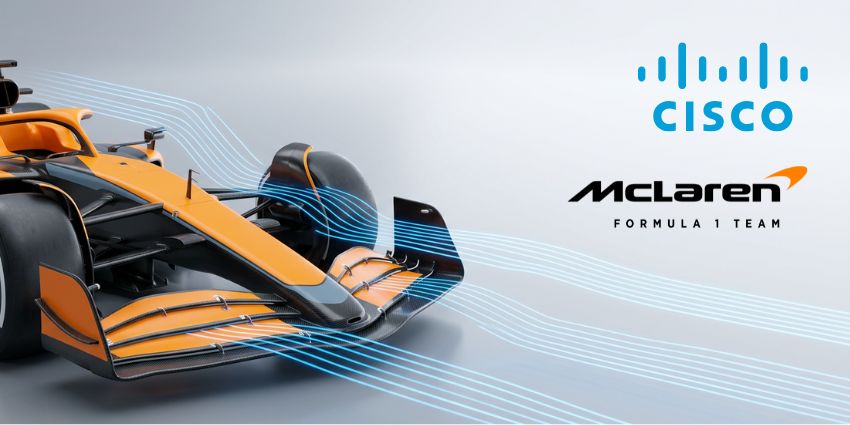

Cisco and McLaren Mastercard Formula 1 have extended their partnership to cover AI-driven observability.
It’s the latest step in a relationship that has grown steadily since Webex first became the team’s collaboration platform five years ago. Splunk’s existing relationship with McLaren Racing now sits under Cisco, following Cisco’s acquisition of the observability vendor. That gives the team a single supplier across communications, networking, security and data monitoring.
What began as a deal to help a geographically scattered race team communicate has become a much broader infrastructure relationship, one that now touches almost every layer of how McLaren runs its operation.
A Partnership That Started With Team Communications
The relationship dates back to 2021, when Cisco Webex became McLaren Racing’s Official Collaboration Partner. The brief was practical rather than ambitious. McLaren’s engineers, strategists and race crews are spread across multiple countries and time zones, and the team needed a single platform to keep them connected during race weekends. Webex also powered Slipstream, McLaren’s livestreaming service for commercial partners. The Webex branding that appeared on the team’s cars and race suits made the deal one of the more visible technology partnerships on the F1 grid.
That first phase proved to be a foundation rather than an endpoint. By 2023, Cisco and McLaren had expanded into Webex Hologram, Cisco’s augmented reality platform for photorealistic 3D meeting participants. McLaren used it to let design engineers examine components remotely from every angle, cutting down on the travel and cost of flying specialists to the track. Two years later, the team moved on again, adopting Cisco’s AI Assistant for Webex to automate meeting summaries and speed up internal decision-making.
Ed Green, Head of Commercial Technology at McLaren Racing, explains why the team kept returning to Cisco for each new capability. “With our team dispersed across the globe, communication is critical,” Green says. “We need speed and accuracy, just like on the track.” That same requirement, communication and decisions that keep pace with a sport measured in milliseconds, has carried through every stage of the partnership since.
Splunk Consolidation Brings Observability Into the Deal
The newest phase folds Splunk into that same relationship. McLaren Racing already had a working relationship with Splunk before Cisco’s acquisition of the company closed. That relationship now sits inside Cisco’s portfolio, rather than running as a separate vendor arrangement. In practice, McLaren’s network, security and application data can now be monitored through the same infrastructure stack that already carries its communications and connectivity, rather than through a parallel set of tools and contracts.
For a Formula 1 team, the volume of data involved is significant. Cars, garages and race operations generate constant telemetry, and any gap in visibility into that data can translate directly into lost track time. Cisco is framing the Splunk consolidation as removing one such gap, giving McLaren a single, AI-assisted view across infrastructure that previously required switching between systems.
Bryan Jones, SVP of Global Revenue, Field and Partner Marketing at Cisco, says the extended deal also matters to Cisco beyond the track:
“When a championship team like McLaren Mastercard F1 chooses to build their future on the full power of the Cisco portfolio, that validates our unified approach. Seeing our technology at the heart of their operations, there is no more powerful proof point to demonstrate to our customers that Cisco is the critical infrastructure for the AI era.”
The comment reflects a challenge Cisco has faced since closing its Splunk acquisition. It needs to prove that Splunk’s observability tools are genuinely integrated into its broader AI and networking portfolio, not sitting alongside it as a separate product line. A visible, high-performance customer like McLaren gives Cisco a concrete example to point to.
Why the Cost Cap Adds Weight to McLaren’s Investment
McLaren is F1’s reigning back-to-back Constructors’ Champion. It also operates under the sport’s cost cap, which limits how much a team can spend on car development each season.
That constraint gives McLaren’s continued investment in Cisco technology a different weight than it would carry in an uncapped environment. Every pound spent on infrastructure is a pound that cannot go into the car. A title-winning team choosing to deepen its Cisco footprint, rather than pare it back, points to a partnership McLaren considers worth that trade-off.